>
Gobiiformes (Gobies) >
Gobiidae (Gobies) > Gobionellinae
Etymology: Pseudogobius: Greek, pseudes = false + Latin, gobius = gudgeon (Ref. 45335); aquilonius: Name from Latin 'aquilonius' meaning north or northerly, referring to the species’ distribution around the north coast of Australia.
Ambiente: milieu / zona climática / intervalo de profundidade / gama de distribuição
Ecologia
marinhas; estuarina demersal; intervalo de profundidade 0 - 1 m (Ref. 126575). Subtropical
Indo-Western Pacific: Australia (northern Australia from from Dampier, Western Australia to Brisbane, east coast Queensland); possibly New Guinea but no samples were found.
Tamanho / Peso / Idade
Maturidade: Lm ? range ? - ? cm
Max length : 3.3 cm SL macho/indeterminado; (Ref. 126575)
Descrição breve
Chaves de identificação | Morfologia | Morfometria
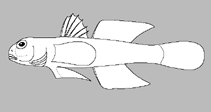
Espinhos dorsais (total) : 7; Raios dorsais moles (total) : 6 - 8; Espinhos anais: 1; Raios anais moles: 6 - 7. This moderate-sized species is distinguished by the following characters: D2 I,6-8 (usually I,7); A I,6-7 (usually 7); pectoral rays 14-17 (usually 16); segmented caudal rays 15-16 in 9/7 pattern; lateral scales 24-27; transverse scale count 7-9; predorsal scales 6-8; opercle with at least 2 rows of cycloid scales and rarely with a cycloid scale on cheek, right behind the eye; shoulder girdle is smooth or with a narrow bony flange; tongue is short, may be greatly reduced; in males, teeth in outer row of upper jaw are slightly flattened, blunt-tipped or pointed, with two curved symphyseal canines behind anterior tooth rows; females with outer row teeth of upper jaw small, compressed and blunt-tipped; scale margins edged with brown, about 5-6 small brown elongate blotches along mid-side of the body and posteriormost blotch at hypural crease extending onto caudal fin and
coalescing with narrow vertical dark bar on fin base (Ref. 126575),
Cross section: oval.
This species occupies shallow-water estuarine, found in tidal rivers, mangrove creeks and muddy tide-pools, at depths of 0–1 m, on sandy mud, mud and mangrove roots, logs and leaf litter. It is found among a variety of mangroves, e.g. Aegialitis, Avicennia, Ceriops, Exoecaria, Rhizophora and often in marginal habitats such as small drainage creeks that runs through exposed salt flats. Associated with other species in its microhabitat or location in northern Australia including a minor overlap with Pseudogobius eos around Brisbane) (Ref. 126575).
Ciclo de vida e comportamento de acasalamento
Maturidade | Reprodução | Desova | Ovos | Fecundidade | Larvas
Larson, H.K. and M.P. Hammer, 2021. A revision of the gobiid fish genus Pseudogobius (Teleostei, Gobiidae, Tridentigerinae), with description of seven new species from Australia and South-east Asia. Zootaxa 4961(1):1-85. (Ref. 126575)
Categoria na Lista Vermelha da IUCN (Ref. 130435: Version 2025-2 (Global))
Ameaça para o homem
Harmless
Utilização humana
Ferramentas
Relatórios especiais
Descarregue XML
Fontes da internet
Estimativas baseadas em modelos
Índice de diversidade filogenética (Ref.
82804): PD
50 = 0.5000 [Uniqueness, from 0.5 = low to 2.0 = high].
Bayesian length-weight: a=0.00708 (0.00332 - 0.01511), b=3.07 (2.89 - 3.25), in cm total length, based on LWR estimates for this (Sub)family-body shape (Ref.
93245).
Nível Trófico (Ref.
69278): 3.2 ±0.5 se; based on size and trophs of closest relatives
Resiliência (Ref.
120179): Elevada, tempo mínimo de duplicação da população menor que 15 meses (Preliminary K or Fecundity.).
Vulnerabilidade da pesca (Ref.
59153): Low vulnerability (10 of 100).
🛈