Clasificación / Nombres
Nombres comunes | Sinónimos | Catalog of Fishes(Género, Especie) | ITIS | CoL | WoRMS | Cloffa
>
Cichliformes (Cichlids, convict blennies) >
Cichlidae (Cichlids) > Pseudocrenilabrinae
Etymology: Haplochromis: Greek, Haploos = single + Greek, chromis = a fish, perhaps a perch (Ref. 45335); pardus: Specific name from the Latin 'pardus' for 'leopard'; referring to nearly uniform black to yellow-pink flanks with clear black blotches, i.e.,, interrupted horizontal and vertical stripes (Ref. 126312).
Entorno: milieu / zona climática / rango de profundidad / gama de distribución
Ecología
; agua dulce pelágico. Tropical
Africa: Lake Edward (Ref. 126312).
Tamaño / Peso / Edad
Madurez: Lm ? range ? - ? cm
Max length : 9.6 cm SL macho / no sexado; (Ref. 126312)
Descripción breve
Claves de identificación | Morfología | Morfometría
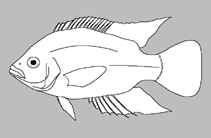
Espinas dorsales (total) : 15 - 16; Radios blandos dorsales (total) : 8 - 10; Espinas anales: 3; Radios blandos anales: 8 - 10; Vértebra: 29 - 30. Diagnosis: Species with a piscivorous morphology; adult size small, maximum known size 96 mm standard length; outer oral teeth many and small, 39-56; dominant males speckled to uniformly black (Ref. 126312). Amongst piscivorous species from the Lake Edward system, H. pardus differs from all by the combination of a smaller adult size, maximum standard length 96 mm vs. 109-211 mm; and colour pattern of small specimens of less than 100 mm standard length speckled to uniformly black vs. light coloured (Ref. 126312). It further differs from H. latifrons, H. mentatus, H. glaucus, H. kimondo and H. squamipinnis by the combination of a shallower cheek, cheek depth 20.8-24.4% of head length vs. 23.8-36.0%; and a narrower interorbital area, interorbital width 39.3-48.4% of head width vs. 48.6-63.3% (Ref. 126312). It further differs from H. rex, H. simba and H. aquila by the combination of a shallower cheek, cheek depth 20.8-24.4% of head length vs. 26.8-33.5%; smaller outer oral teeth; and a larger number of outer upper jaw teeth, 39-51 vs. 22-37 (Ref. 126312). It further differs from H. falcatus by the combination of weakly recurved vs. strongly recurved outer jaw teeth; a shallower cheek, cheek depth 20.8-24.4% of head length vs. 25.1-28.0%; and a shorter pre-dorsal distance, 34.1-37.8% of standard length vs. 38.2-41.1% (Ref. 126312). It further differs from H. curvidens by the combination of a longer anal-fin base, 19.2-22.2% of standard length vs. 17.9-18.6%; and a slightly narrower interorbital area, interorbital width 39.3-48.4% of head width vs. 46.4-52.5% (Ref. 126312). It further differs from H. quasimodo by the combination of a shallower cheek, cheek depth 20.8-24.4% of head length vs. 23.7-32.9%; and a smaller number of caudal peduncle scales, 16, rarely 17, vs. 17-20, rarely 16 (Ref. 126312).
Found in inshore areas (Ref. 126312). Based on its morphology, most probably a piscivorous species (Ref. 126312).
Ciclo vital y comportamiento de apareamiento
Madurez | Reproducción | Puesta | Huevos | Fecundidad | Larva
Vranken, N., M. Van Steenberge, A. Heylen, E. Decru and J. Snoeks, 2022. From a pair to a dozen: the piscivorous species of Haplochromis (Cichlidae) from the Lake Edward system. Eur. J. Taxon. 815:1-94. (Ref. 126312)
Situación en la Lista Roja de la UICN (Ref. 130435: Version 2025-2 (Global))
Amenaza para el ser humano
Harmless
Usos humanos
Herramientas
Informes especiales
Descargar XML
Fuentes de Internet
Estimaciones basadas en modelos
Índice de diversidad filogenética (Referencia
82804): PD
50 = 0.5000 [Uniqueness, from 0.5 = low to 2.0 = high].
Bayesian length-weight: a=0.01445 (0.00671 - 0.03113), b=2.99 (2.82 - 3.16), in cm total length, based on LWR estimates for this (Sub)family-body shape (Ref.
93245).
Nivel trófico (Referencia
69278): 3.3 ±0.4 se; based on size and trophs of closest relatives
Resiliencia (Referencia
120179): Alto, población duplicada en un tiempo mínimo inferior a 15 meses (Preliminary K or Fecundity.).
Vulnerabilidad pesquera (Ref.
59153): Low vulnerability (10 of 100).
🛈