分類 / 名前
共通名の | 類義語 | Catalog of Fishes(部類, 種) | ITIS | CoL | WoRMS | Cloffa
>
Cichliformes (Cichlids, convict blennies) >
Cichlidae (Cichlids) > Pseudocrenilabrinae
Etymology: Haplochromis: Greek, Haploos = single + Greek, chromis = a fish, perhaps a perch (Ref. 45335); pardus: Specific name from the Latin 'pardus' for 'leopard'; referring to nearly uniform black to yellow-pink flanks with clear black blotches, i.e.,, interrupted horizontal and vertical stripes (Ref. 126312).
環境:環境 / 気候帯 / 深さの範囲 / 分布範囲
生態学
; 新鮮な水 外洋の. Tropical
Africa: Lake Edward (Ref. 126312).
サイズ / 重さ / 年齢
成熟: Lm ? range ? - ? cm
Max length : 9.6 cm SL オス/雌雄の選別がない; (Ref. 126312)
簡単な記述
検索表 | 形態学 | 形態計測学
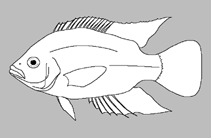
背面の脊椎 (合計) : 15 - 16; 背鰭 (合計) : 8 - 10; 肛門の骨: 3; 臀鰭: 8 - 10; 脊つい: 29 - 30. Diagnosis: Species with a piscivorous morphology; adult size small, maximum known size 96 mm standard length; outer oral teeth many and small, 39-56; dominant males speckled to uniformly black (Ref. 126312). Amongst piscivorous species from the Lake Edward system, H. pardus differs from all by the combination of a smaller adult size, maximum standard length 96 mm vs. 109-211 mm; and colour pattern of small specimens of less than 100 mm standard length speckled to uniformly black vs. light coloured (Ref. 126312). It further differs from H. latifrons, H. mentatus, H. glaucus, H. kimondo and H. squamipinnis by the combination of a shallower cheek, cheek depth 20.8-24.4% of head length vs. 23.8-36.0%; and a narrower interorbital area, interorbital width 39.3-48.4% of head width vs. 48.6-63.3% (Ref. 126312). It further differs from H. rex, H. simba and H. aquila by the combination of a shallower cheek, cheek depth 20.8-24.4% of head length vs. 26.8-33.5%; smaller outer oral teeth; and a larger number of outer upper jaw teeth, 39-51 vs. 22-37 (Ref. 126312). It further differs from H. falcatus by the combination of weakly recurved vs. strongly recurved outer jaw teeth; a shallower cheek, cheek depth 20.8-24.4% of head length vs. 25.1-28.0%; and a shorter pre-dorsal distance, 34.1-37.8% of standard length vs. 38.2-41.1% (Ref. 126312). It further differs from H. curvidens by the combination of a longer anal-fin base, 19.2-22.2% of standard length vs. 17.9-18.6%; and a slightly narrower interorbital area, interorbital width 39.3-48.4% of head width vs. 46.4-52.5% (Ref. 126312). It further differs from H. quasimodo by the combination of a shallower cheek, cheek depth 20.8-24.4% of head length vs. 23.7-32.9%; and a smaller number of caudal peduncle scales, 16, rarely 17, vs. 17-20, rarely 16 (Ref. 126312).
Found in inshore areas (Ref. 126312). Based on its morphology, most probably a piscivorous species (Ref. 126312).
ライフサイクルと交尾行動
成熟 | 繁殖 | 放精 | 卵 | 生産力 | 幼生
Vranken, N., M. Van Steenberge, A. Heylen, E. Decru and J. Snoeks, 2022. From a pair to a dozen: the piscivorous species of Haplochromis (Cichlidae) from the Lake Edward system. Eur. J. Taxon. 815:1-94. (Ref. 126312)
IUCNのレッドリストの状況は (Ref. 130435: Version 2025-2 (Global))
人間の用途
用具
特記事項
XMLをダウンロードして下さい
インターネットの情報源
モデルに基づく推定値
系統多様性指数 (参照
82804): PD
50 = 0.5000 [Uniqueness, from 0.5 = low to 2.0 = high].
Bayesian length-weight: a=0.01445 (0.00671 - 0.03113), b=2.99 (2.82 - 3.16), in cm total length, based on LWR estimates for this (Sub)family-body shape (Ref.
93245).
栄養段階 (参照
69278): 3.3 ±0.4 se; based on size and trophs of closest relatives
回復力 (参照
120179): 高い, 15か月以下の倍増期間の最小個体群 (Preliminary K or Fecundity.).
漁業の脆弱性 (Ref.
59153): Low vulnerability (10 of 100).
🛈