Ταξινόμηση / Ονόματα
Κοινά ονόματα | Συνώνυμα | Catalog of Fishes(Γένος, Είδη) | ITIS | CoL | WoRMS | Cloffa
>
Cichliformes (Cichlids, convict blennies) >
Cichlidae (Cichlids) > Pseudocrenilabrinae
Etymology: Haplochromis: Greek, Haploos = single + Greek, chromis = a fish, perhaps a perch (Ref. 45335); rex: Specific name from the Latin 'rex' for 'king', one that holds a preeminent position; referring to very small eyes, deep cheeks, and strong jaws set with large and acute teeth indicating this piscivore has most specialised morphology among all piscivores from the Lake Edward system to hunt on large prey (Ref. 126312).
Περιβάλλον: περιβάλλον / κλιματική ζώνη / εύρος βάθους / εύρος διανομής
Οικολογία
; Γλυκού νερού Πελαγικό(ά). Tropical
Africa: Lake Edward (Ref. 126312).
Μέγεθος / Βάρος / Ηλικία
Γεννητική Ωρίμανση: Lm ? range ? - ? cm
Max length : 15.5 cm SL αρσενικό/απροσδιόριστο; (Ref. 126312)
Σύντομη περιγραφή
Κλείδες προσδιορισμού | Μορφολογία | Μορφομετρία
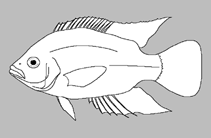
Ραχιαίες άκανθες (συνολικά) : 14 - 16; Μαλακές ραχιαίες ακτίνες (συνολικά) : 9 - 11; Εδρικές άκανθες: 3; Μαλακές εδρικές ακτίνες: 8 - 10; Σπόνδυλοι: 29 - 31. Diagnosis: Species with a piscivorous morphology; head narrow, head width 36.8-41.6% of head length; cheek deep, cheek depth 27.6-33.5% of head length; eye small, eye diameter 22.2-28.3% of head length; outer oral teeth few and large, 24-36; dominant males cream-coloured with an orange operculum and a light blue snout (Ref. 126312). Amongst piscivorous species from the Lake Edward system, Haplochromis rex differs from H. latifrons and H. mentatus by the combination of a shorter caudal peduncle, caudal peduncle length 13.5-16.2% of standard length vs. 15.7-18.0%; and a narrower interorbital area, interorbital width 44.9-52.7% of head width vs. 51.3-63.3%; further from H. latifrons by absence vs. presence of a well-defined mid-lateral band; further from H. mentatus by dominant males cream-coloured with an orange operculum vs. yellow-green with a red anterior part of flank (Ref. 126312). It differs from H. simba by a combination of a larger number of longitudinal line scales, 34-38 vs. 32-33; a larger number of scales between first anal-fin spine and upper lateral line, 12-16 vs. 9-11; absent or weakly developed vs. strongly developed mental prominence; and dominant males cream-coloured with an orange operculum and a light blue snout vs. yellow with an orange anterior part of flank and a yellow snout (Ref. 126312). It differs from H. glaucus by the combination of a narrower interorbital area, interorbital width 44.9-52.7% of head width vs. 50.9-57.1%; a steeper snout, 40-50° vs. 30-40°; rounded vs. acute oral jaws in dorsal view; and dominant males cream-coloured with an orange operculum and a light blue snout vs. uniformly light blue with a dusky snout (Ref. 126312). It differs from H. aquila by the combination of a deeper lacrimal, lacrimal depth 18.9-22.5% of head length vs. 17.0-19.1%; smaller eye, eye diameter 22.2-28.3% of head length vs. 30.0-31.5%; and dominant males cream-coloured with an orange operculum vs. light grey with a black head (Ref. 126312).It differs from H. kimondo, H. falcatus, H. curvidens, H. pardus, H. quasimodo and H. squamipinnis by the combination of stout vs. slim oral jaws; large vs. small outer oral teeth; and a smaller number of outer upper jaw teeth, 24-36 vs. 39-79; it further differs from H. kimondo, H. curvidens and H. quasimodo by a narrower head, head width 36.8-41.6% of head length vs. 42.0-48.1%; further from H. kimondo and H. quasimodo by dominant males cream-coloured with an orange operculum vs. grey dorsally and yellow or blue-black ventrally; it further differs from H. falcatus, H. pardus and H. squamipinnis by a larger number of longitudinal line scales, 34-38 vs. 29-33, rarely 34; and dominant males cream-coloured with an orange operculum vs. uniformly olive-green with an orange-red anterior part of flank, speckled to uniformly black, or uniformly slate blue, respectively (Ref. 126312).
Found over sandy substrates (Ref. 126312). Based on its morphology, most probably a piscivorous species (Ref. 126312).
Κύκλος ζωής και συμπεριφορά ζευγαρώματος
Γεννητική Ωρίμανση | Αναπαραγωγή | Γεννοβολία | Αβγά | Γονιμότητα | Προνύμφες
Vranken, N., M. Van Steenberge, A. Heylen, E. Decru and J. Snoeks, 2022. From a pair to a dozen: the piscivorous species of Haplochromis (Cichlidae) from the Lake Edward system. Eur. J. Taxon. 815:1-94. (Ref. 126312)
Κατάσταση Κόκκινου Καταλόγου IUCN (Ref. 130435: Version 2025-2 (Global))
Απειλή για τον άνθρωπο
Harmless
Ανθρώπινες χρήσεις
Εργαλεία
Ειδικές εκθέσεις
Λήψη XML
Διαδικτυακές πηγές
Εκτιμήσεις βάσει μοντέλων
Δείκτης φυλογενετικής ποικιλότητας (Αναφ.
82804): PD
50 = 0.5000 [Uniqueness, from 0.5 = low to 2.0 = high].
Bayesian length-weight: a=0.01445 (0.00671 - 0.03113), b=2.99 (2.82 - 3.16), in cm total length, based on LWR estimates for this (Sub)family-body shape (Ref.
93245).
Τροφικό Επίπεδο (Αναφ.
69278): 3.4 ±0.5 se; based on size and trophs of closest relatives
Ελαστικότητα (Αναφ.
120179): Υψηλό, ελάχιστος χρόνος για διπλασιασμό πληθυσμού < 15 μήνες (Preliminary K or Fecundity.).
Ευπάθεια στην αλιεία (Ref.
59153): Low vulnerability (10 of 100).
🛈