分類 / 名稱
俗名 | 同種異名 | Catalog of Fishes(屬, 種) | ITIS | CoL | WoRMS | Cloffa
Teleostei >
Cichliformes (Cichlids, convict blennies)
鱸形目 (Cichlids, convict blennies) >
Cichlidae (Cichlids)
慈鯛科魚類 (Cichlids) > Pseudocrenilabrinae
Etymology: Haplochromis: Greek, Haploos = single + Greek, chromis = a fish, perhaps a perch (Ref. 45335); rex: Specific name from the Latin 'rex' for 'king', one that holds a preeminent position; referring to very small eyes, deep cheeks, and strong jaws set with large and acute teeth indicating this piscivore has most specialised morphology among all piscivores from the Lake Edward system to hunt on large prey (Ref. 126312).
環境: 環境 / 氣候帶 / 深度上下限 / 配送範圍
生態學
; 淡水 大洋性.
Africa: Lake Edward (Ref. 126312).
大小 / 重量 / 年齡
成熟度: Lm ? range ? - ? cm
Max length : 15.5 cm SL 雄魚/尚未辨別雌雄; (Ref. 126312)
簡短描述
檢索表 | 型態特徵 | 形態測量圖
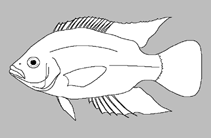
背棘 (總數) : 14 - 16; 背的軟條 (總數) : 9 - 11; 臀棘: 3; 臀鰭軟條: 8 - 10; 脊椎骨: 29 - 31. Diagnosis: Species with a piscivorous morphology; head narrow, head width 36.8-41.6% of head length; cheek deep, cheek depth 27.6-33.5% of head length; eye small, eye diameter 22.2-28.3% of head length; outer oral teeth few and large, 24-36; dominant males cream-coloured with an orange operculum and a light blue snout (Ref. 126312). Amongst piscivorous species from the Lake Edward system, Haplochromis rex differs from H. latifrons and H. mentatus by the combination of a shorter caudal peduncle, caudal peduncle length 13.5-16.2% of standard length vs. 15.7-18.0%; and a narrower interorbital area, interorbital width 44.9-52.7% of head width vs. 51.3-63.3%; further from H. latifrons by absence vs. presence of a well-defined mid-lateral band; further from H. mentatus by dominant males cream-coloured with an orange operculum vs. yellow-green with a red anterior part of flank (Ref. 126312). It differs from H. simba by a combination of a larger number of longitudinal line scales, 34-38 vs. 32-33; a larger number of scales between first anal-fin spine and upper lateral line, 12-16 vs. 9-11; absent or weakly developed vs. strongly developed mental prominence; and dominant males cream-coloured with an orange operculum and a light blue snout vs. yellow with an orange anterior part of flank and a yellow snout (Ref. 126312). It differs from H. glaucus by the combination of a narrower interorbital area, interorbital width 44.9-52.7% of head width vs. 50.9-57.1%; a steeper snout, 40-50° vs. 30-40°; rounded vs. acute oral jaws in dorsal view; and dominant males cream-coloured with an orange operculum and a light blue snout vs. uniformly light blue with a dusky snout (Ref. 126312). It differs from H. aquila by the combination of a deeper lacrimal, lacrimal depth 18.9-22.5% of head length vs. 17.0-19.1%; smaller eye, eye diameter 22.2-28.3% of head length vs. 30.0-31.5%; and dominant males cream-coloured with an orange operculum vs. light grey with a black head (Ref. 126312).It differs from H. kimondo, H. falcatus, H. curvidens, H. pardus, H. quasimodo and H. squamipinnis by the combination of stout vs. slim oral jaws; large vs. small outer oral teeth; and a smaller number of outer upper jaw teeth, 24-36 vs. 39-79; it further differs from H. kimondo, H. curvidens and H. quasimodo by a narrower head, head width 36.8-41.6% of head length vs. 42.0-48.1%; further from H. kimondo and H. quasimodo by dominant males cream-coloured with an orange operculum vs. grey dorsally and yellow or blue-black ventrally; it further differs from H. falcatus, H. pardus and H. squamipinnis by a larger number of longitudinal line scales, 34-38 vs. 29-33, rarely 34; and dominant males cream-coloured with an orange operculum vs. uniformly olive-green with an orange-red anterior part of flank, speckled to uniformly black, or uniformly slate blue, respectively (Ref. 126312).
Found over sandy substrates (Ref. 126312). Based on its morphology, most probably a piscivorous species (Ref. 126312).
生命週期和交配行為
成熟度 | 繁殖 | 產卵場 | 卵 | 孕卵數 | 仔魚
Vranken, N., M. Van Steenberge, A. Heylen, E. Decru and J. Snoeks, 2022. From a pair to a dozen: the piscivorous species of Haplochromis (Cichlidae) from the Lake Edward system. Eur. J. Taxon. 815:1-94. (Ref. 126312)
IUCN 瀕危狀態 (Ref. 130435: Version 2025-2 (Global))
人類使用
工具
特別的報告
下載 XML
網路資源
基於模型的估計
系統發育多樣性指數 (參考文獻
82804): PD
50 = 0.5000 [Uniqueness, from 0.5 = low to 2.0 = high].
Bayesian length-weight: a=0.01445 (0.00671 - 0.03113), b=2.99 (2.82 - 3.16), in cm total length, based on LWR estimates for this (Sub)family-body shape (Ref.
93245).
營養階層 (參考文獻
69278): 3.4 ±0.5 se; based on size and trophs of closest relatives
回復力 (參考文獻
120179): 高度, 族群倍增時間少於 15個月 (Preliminary K or Fecundity.).
釣魚的脆弱性 (Ref.
59153): Low vulnerability (10 of 100).
🛈