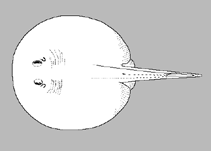
Lớp phụ Cá sụn (cá mập và cá đuối) (sharks and rays) >
Myliobatiformes (Stingrays) >
Potamotrygonidae (River stingrays) > Potamotrygoninae
Etymology: Paratrygon: Greek, para in the side of + Greek, trygon = a sting ray (Ref. 45335); orinocensis: Named for its type locality, Orinoco basin; a toponym.
Môi trường: môi trường / vùng khí hậu / Mức độ sâu / phạm vi phân phối
Sinh thái học
; nước ngọt gần đáy. Tropical
South Anerica: Colombia.
Bộ gần gũi / Khối lượng (Trọng lượng) / Tuổi
Chín muồi sinh dục: Lm ? range ? - ? cm
Max length : 58.4 cm TL con đực/không giới tính; (Ref. 125391)
Mô tả ngắn gọn
Khóa để định loại | Hình thái học | Sinh trắc học
This species is distinguished from its congeners by the following set of characters: lateral rows of thorns on tail absent (vs. present); dermal denticles on the central region of the disc have wide and high crowns, presenting a central coronal plate very similar morphologically to its lateral coronal ridges, which in adults can be more than 12 (vs. small dermal denticles on the central disc, with high and narrow crowns presenting higher and pointed central coronal plates surrounded by minor, pointed or rounded lateral coronal ridges, which in turn vary between three and six); teeth 22-35/20-29 (vs.16-26/14-20 in aiereba and 31/19-22 parvaspina); central teeth with more developed and high cusps than aiereba, parvaspina; spiracles are small and triangular, with mean length 5.6% DW [4.5-7.9% DW] (vs. quadrangular and larger spiracles in aiereba with mean length 6% DW [4.4-11.6% DW], and very small and quadrangular spiracles in parvaspina with mean length 5.2% DW [4.9-5.8% DW]; with a short and straight spiracular process with developed and numerous dermal denticles (vs. larger and knob shaped spiracular process that almost covers the spiracle aperture and with some small dermal denticles in aiereba, and an extremely short and reduced spiracular process in parvaspina that is more perceptible in adult specimens, with few dermal denticles); with a minute rostral projection (vs. with a relatively large rostral projection in aiereba, and with a large and circular rostral projection in parvaspina) (Ref. 125391).
Cross section: flattened.
Vòng đời và hành vi giao phối
Chín muồi sinh dục | Sự tái sinh sản | Đẻ trứng | Các trứng | Sự sinh sản | Ấu trùng
Loboda, T.S., C.A. Lasso, R. de Souza Rosa and M.R. de Carvalho, 2021. Two new species of freshwater stingrays of the genus Paratrygon (Chondrichthyes: Potamotrygonidae) from the Orinoco basin, with comments on the taxonomy of Paratrygon aiereba. Neotrop. Ichthyol. 19(2). (Ref. 125391)
Tình trạng Sách đỏ IUCN (Ref. 130435: Version 2025-2 (Global))
Mối đe dọa đối với con người
Harmless
Sử dụng của con người
Các công cụ
Báo cáo đặc biệt
Tải xuống XML
Các nguồn internet
Ước tính dựa trên mô hình
Chỉ số đa dạng phát sinh loài (Tài liệu tham khảo
82804): PD
50 = 0.6250 [Uniqueness, from 0.5 = low to 2.0 = high].
Bayesian length-weight: a=0.01000 (0.00244 - 0.04107), b=3.04 (2.81 - 3.27), in cm total length, based on all LWR estimates for this body shape (Ref.
93245).
Mức dinh dưỡng (Tài liệu tham khảo
69278): 3.2 ±0.4 se; based on size and trophs of closest relatives
Sự dễ bị tổn thương của nghề đánh cá (Ref.
59153): Moderate vulnerability (43 of 100).
🛈