Elasmobranquios (tiburones y rayas) (sharks and rays) >
Myliobatiformes (Stingrays) >
Potamotrygonidae (River stingrays) > Potamotrygoninae
Etymology: Paratrygon: Greek, para in the side of + Greek, trygon = a sting ray (Ref. 45335); orinocensis: Named for its type locality, Orinoco basin; a toponym.
Entorno: milieu / zona climática / rango de profundidad / gama de distribución
Ecología
; agua dulce demersal. Tropical
South Anerica: Colombia.
Tamaño / Peso / Edad
Madurez: Lm ? range ? - ? cm
Max length : 58.4 cm TL macho / no sexado; (Ref. 125391)
Descripción breve
Claves de identificación | Morfología | Morfometría
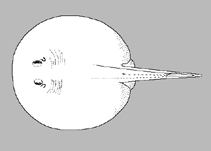
This species is distinguished from its congeners by the following set of characters: lateral rows of thorns on tail absent (vs. present); dermal denticles on the central region of the disc have wide and high crowns, presenting a central coronal plate very similar morphologically to its lateral coronal ridges, which in adults can be more than 12 (vs. small dermal denticles on the central disc, with high and narrow crowns presenting higher and pointed central coronal plates surrounded by minor, pointed or rounded lateral coronal ridges, which in turn vary between three and six); teeth 22-35/20-29 (vs.16-26/14-20 in aiereba and 31/19-22 parvaspina); central teeth with more developed and high cusps than aiereba, parvaspina; spiracles are small and triangular, with mean length 5.6% DW [4.5-7.9% DW] (vs. quadrangular and larger spiracles in aiereba with mean length 6% DW [4.4-11.6% DW], and very small and quadrangular spiracles in parvaspina with mean length 5.2% DW [4.9-5.8% DW]; with a short and straight spiracular process with developed and numerous dermal denticles (vs. larger and knob shaped spiracular process that almost covers the spiracle aperture and with some small dermal denticles in aiereba, and an extremely short and reduced spiracular process in parvaspina that is more perceptible in adult specimens, with few dermal denticles); with a minute rostral projection (vs. with a relatively large rostral projection in aiereba, and with a large and circular rostral projection in parvaspina) (Ref. 125391).
Cross section: flattened.
Ciclo vital y comportamiento de apareamiento
Madurez | Reproducción | Puesta | Huevos | Fecundidad | Larva
Loboda, T.S., C.A. Lasso, R. de Souza Rosa and M.R. de Carvalho, 2021. Two new species of freshwater stingrays of the genus Paratrygon (Chondrichthyes: Potamotrygonidae) from the Orinoco basin, with comments on the taxonomy of Paratrygon aiereba. Neotrop. Ichthyol. 19(2). (Ref. 125391)
Situación en la Lista Roja de la UICN (Ref. 130435: Version 2025-2 (Global))
Amenaza para el ser humano
Harmless
Usos humanos
Herramientas
Informes especiales
Descargar XML
Fuentes de Internet
Estimaciones basadas en modelos
Índice de diversidad filogenética (Referencia
82804): PD
50 = 0.6250 [Uniqueness, from 0.5 = low to 2.0 = high].
Bayesian length-weight: a=0.01000 (0.00244 - 0.04107), b=3.04 (2.81 - 3.27), in cm total length, based on all LWR estimates for this body shape (Ref.
93245).
Nivel trófico (Referencia
69278): 3.2 ±0.4 se; based on size and trophs of closest relatives
Vulnerabilidad pesquera (Ref.
59153): Moderate vulnerability (43 of 100).
🛈