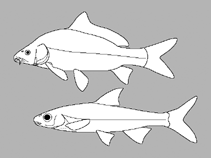
Classificatie / Namen
Lokale namen | Synoniemen | Catalog of Fishes(Genus, Soort(en)) | ITIS | CoL | WoRMS | Cloffa
>
Cypriniformes (Carps) >
Cyprinidae (Minnows or carps) > Barbinae
Etymology: mascarensis: Luciobarbus mascarensis is named for the Mascara region in western Algeria; a noun in genitive, indeclinable (Ref. 115559).
Milieu: milieu / Klimaatzone / Diepte / verspreidingsgebied
Ecologie
; zoet water pelagisch. Subtropical
Africa: Macta River drainage and Tifrit River in northwestern Algeria (Ref. 115559, 121680).
Grootte / Gewicht / Leeftijd
Maturiteit: Lm ? range ? - ? cm
Max length : 18.8 cm SL mannelijk / geslacht onbekend; (Ref. 115559)
Korte beschrijving
Determinatiesleutels | Morfologie | Morfometrie
Dorsale stekels (totaal) : 0; Dorsale zachte stralen (totaal) : 12; Anale stekels: 0; Anale zachte stralen: 8. Diagnosis: Luciobarbus mascarensis is distinguished from other Luciobarbus species from the African Mediterranean basin, except L. chelifensis and L. leptopogon, by having usually 41 + 1-2 lateral line scales, vs. 49-51 + 1-2 in L. biscarensis, 43-47 + 1-2 in L. callensis, 43-45 + 1-3 in L. rifensis and L. setivimensis, 42-45 + 1-2 in L. yahyaouii; only L. chelifensis and L. leptopogon have regularly 41 lateral-line scales on the flank (Ref. 115559). Luciobarbus mascarensis is distinguished from L. chelifensis by having a longer anal fin, 19-22% of standard length vs. 18-19%, and the dorsal fin serrated at 2/3 of its length vs. serrated along almost its entire length, and from L. leptopogon by having a deeper body, body depth at dorsal-fin origin 26-31% of standard length vs. 20-27%, and a wider caudal peduncle, caudal peduncle depth 74-84% of caudal peduncle length vs. 60-74% (Ref. 115559). Luciobarbus mascarensis is also distinguished from L. biscarensis by having 7.5 scale rows between the lateral line and the dorsal-fin origin vs. 8.5-9.5, 4.5-5.5 scale rows between the lateral line and the pelvic-fin origin vs. 7.5-8.5, 4 unbranched dorsal-fin rays vs. 5, the dorsal-fin origin situated in front or above the pelvic-fin origin vs. behind, a longer anal fin, 19-22% of standard length vs. 17-20%, a short caudal peduncle, caudal peduncle length 15-17% of standard length vs. 16-19%; it is further distinguished from L. callensis and L. rifensis by having a longer anal fin, 19-22% of standard length vs. 17-19% in L. callensis and 16-19% in L. rifensis, a wider anal-fin base, 7-10% of standard length vs. 6-8% in L. rifensis, and a wider caudal peduncle, caudal peduncle depth 74-84% of caudal peduncle length vs. 60-78% in L. rifensis; it is also distinguihed from L. setivimensis by having a more narrow interorbital distance, 36-40% of head length vs. 40-44%; it is also distinguished from L. yahyaouii by having 4 unbranched dorsal-fin rays vs. usually 5, a greater distance between the pelvic and anal-fin origins, 24-28% of standard length vs. 21-24%, and a shorter caudal peduncle, caudal peduncle length 15-17% of standard length vs. 16-19.4% (Ref. 115559).
Levenscyclus en paargedrag
Maturiteit | Voortplanting | Paaien | Eieren | Fecunditeit | Larven
Brahimi, A., J. Freyhof, A. Henrard and R. Libois, 2017. Luciobarbus chelifensis and L. mascarensis, two new species from Algeria (Teleostei: Cyprinidae). Zootaxa 4277(1):32-50. (Ref. 115559)
Status op de Rode Lijst van het IUCN (Ref. 130435: Version 2025-2 (Global))
Bedreigd (EN) (B1ab(i,ii,iii,v)+2ab(i,ii,iii,v)); Date assessed: 17 May 2021
Gevaar voor de mens
Harmless
Gebruik door de mens
Tools
Speciale rapporten
Download XML
Internetbronnen
Schattingen op basis van modellen
Fylogenetische diversiteitsindex (Ref.
82804): PD
50 = 0.5000 [Uniqueness, from 0.5 = low to 2.0 = high].
Bayesian length-weight: a=0.01047 (0.00504 - 0.02175), b=2.99 (2.82 - 3.16), in cm total length, based on LWR estimates for this Genus-body shape (Ref.
93245).
Trofisch niveau (Ref.
69278): 2.8 ±0.3 se; based on size and trophs of closest relatives
Weerstandsvermogen (Ref.
120179): Gemiddeld, minimale populatieverdubbelingstijd 1,4-4,4 jaar (Preliminary K or Fecundity.).
Kwetsbaarheid van de visserij (Ref.
59153): Low vulnerability (13 of 100).
🛈