This website uses cookies to enhance your browsing experience and ensure the functionality of our site. For more detailed information about the types of cookies we use and how we protect your privacy, please visit our Privacy Information page.
×
Cookie Settings
This website uses different types of cookies to enhance your experience. Please select your preferences below:
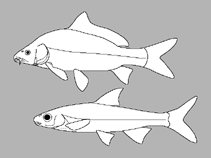
No image available for this species; drawing shows typical species in Cyprinidae.
分類 / 名稱 俗名 | 同種異名 | Catalog of Fishes(屬, 種) | ITIS | CoL | WoRMS | Cloffa
Teleostei > Cypriniformes (Carps) 鯉形目 (Carps) > Cyprinidae (Minnows or carps) 鯉科 (Minnows or carps) > Barbinae
Etymology: mascarensis:Luciobarbus mascarensis is named for the Mascara region in western Algeria; a noun in genitive, indeclinable (Ref. 115559).
背棘 (總數) : 0; 背的軟條 (總數) : 12; 臀棘: 0; 臀鰭軟條: 8. Diagnosis: Luciobarbus mascarensis is distinguished from other Luciobarbus species from the African Mediterranean basin, except L. chelifensis and L. leptopogon, by having usually 41 + 1-2 lateral line scales, vs. 49-51 + 1-2 in L. biscarensis, 43-47 + 1-2 in L. callensis, 43-45 + 1-3 in L. rifensis and L. setivimensis, 42-45 + 1-2 in L. yahyaouii; only L. chelifensis and L. leptopogon have regularly 41 lateral-line scales on the flank (Ref. 115559). Luciobarbus mascarensis is distinguished from L. chelifensis by having a longer anal fin, 19-22% of standard length vs. 18-19%, and the dorsal fin serrated at 2/3 of its length vs. serrated along almost its entire length, and from L. leptopogon by having a deeper body, body depth at dorsal-fin origin 26-31% of standard length vs. 20-27%, and a wider caudal peduncle, caudal peduncle depth 74-84% of caudal peduncle length vs. 60-74% (Ref. 115559). Luciobarbus mascarensis is also distinguished from L. biscarensis by having 7.5 scale rows between the lateral line and the dorsal-fin origin vs. 8.5-9.5, 4.5-5.5 scale rows between the lateral line and the pelvic-fin origin vs. 7.5-8.5, 4 unbranched dorsal-fin rays vs. 5, the dorsal-fin origin situated in front or above the pelvic-fin origin vs. behind, a longer anal fin, 19-22% of standard length vs. 17-20%, a short caudal peduncle, caudal peduncle length 15-17% of standard length vs. 16-19%; it is further distinguished from L. callensis and L. rifensis by having a longer anal fin, 19-22% of standard length vs. 17-19% in L. callensis and 16-19% in L. rifensis, a wider anal-fin base, 7-10% of standard length vs. 6-8% in L. rifensis, and a wider caudal peduncle, caudal peduncle depth 74-84% of caudal peduncle length vs. 60-78% in L. rifensis; it is also distinguihed from L. setivimensis by having a more narrow interorbital distance, 36-40% of head length vs. 40-44%; it is also distinguished from L. yahyaouii by having 4 unbranched dorsal-fin rays vs. usually 5, a greater distance between the pelvic and anal-fin origins, 24-28% of standard length vs. 21-24%, and a shorter caudal peduncle, caudal peduncle length 15-17% of standard length vs. 16-19.4% (Ref. 115559).
Brahimi, A., J. Freyhof, A. Henrard and R. Libois, 2017. Luciobarbus chelifensis and L. mascarensis, two new species from Algeria (Teleostei: Cyprinidae). Zootaxa 4277(1):32-50. (Ref. 115559)
系統發育多樣性指數 (參考文獻 82804): PD50 = 0.5000 [Uniqueness, from 0.5 = low to 2.0 = high].
Bayesian length-weight: a=0.01047 (0.00504 - 0.02175), b=2.99 (2.82 - 3.16), in cm total length, based on LWR estimates for this Genus-body shape (Ref. 93245).
營養階層 (參考文獻 69278): 2.8 ±0.3 se; based on size and trophs of closest relatives
回復力 (參考文獻 120179): 中等的, 族群倍增時間最少 1.4 - 4.4年 (Preliminary K or Fecundity.).
釣魚的脆弱性 (Ref. 59153): Low vulnerability (13 of 100). 🛈