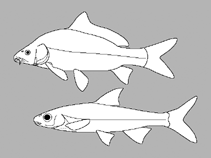
Classificação / Nomes
Nomes comuns | Sinônimos | Catalog of Fishes(Gênero, Espécies) | ITIS | CoL | WoRMS | Cloffa
>
Cypriniformes (Carps) >
Cyprinidae (Minnows or carps) > Barbinae
Etymology: lanigarensis: Luciobarbus lanigarensis is named for Lanigar, the old name of Ouajda province, given by Claudius Ptolemaeus (100-170); an adjective (Ref. 121680).
Meio ambiente: milieu / Zona climática / intervalo de profundidade / faixa de distribuição
Ecologia
; Água doce pelágico(a,os,as). Subtropical
Africa: Isly River in northeastern Morocco (Ref. 121680).
Tamanho / Peso / Idade
Maturidade: Lm ? range ? - ? cm
Max length : 15.0 cm SL macho/indeterminado; (Ref. 121680)
Descrição suscinta
Chaves de identificação | Morfologia | Morfometria
Espinhos dorsais (total) : 0; Raios dorsais (total) : 12; Espinhos anais: 0; Raios anais : 8. Diagnosis: Luciobarbus lanigarensis is distinguished from other Luciobarbus species from the African Mediterranean Sea basin by a combination of characters, none of them unique (Ref. 121680). It is distinguished from L. guercifensis by having thin barbels vs. thick, the rostral-barbel origin placed clearly behind the tip of the snout, vs. rostral-barbel origin at the extreme anterior of the snout, and from L. mascarensis, L. yahyaouii and L. leptopogon, by having a wider interorbital distance, 38-47% of head length vs. 36-40% in L. mascarensis, 33-40% in L. yahyaouii, 36-39% in L. leptopogon, and a longer pectoral-fin, 21-24% of standard length vs. 16-21% in L. mascarensis, 18-21% in L. yahyaouii; it is further distinguished from L. chelifensis, L. leptopogon and L. mascarensis by having 43-45 + 1-3 lateral line scales, vs. 41-43 + 1-2 in L. chelifensis and L. leptopogon, usually 41 + 1-2 in L. mascarensis (Ref. 121680). It is distinguished from L. callensis, L. chelifensis and L. rifensis by having the last unbranched dorsal-fin ray serrated along 2/3 of its length, vs. last unbranched dorsal-fin ray serrated along almost its entire length, and a longer anal fin, 19-23% of standard length vs. 17-19% in L. callensis and L. chelifensis, 16-19% in L. rifensis; it is also distinguished from L. leptopogon and L. setivimensis by having a greater pre-dorsal distance, 53-59% of standard length vs. 49-52% in L. leptopogon, 47-52% in L. setivimensis (Ref. 121680).
Ciclo de vida ou comportamento de acasalamento
Maturidade | Reprodução | Desova | Ovos | Fecundidade | Larvas
Brahimi, A., R. Libois, A. Henrard and J. Freyhof, 2018. Luciobarbus lanigarensis and L. numidiensis, two new species of barbels from the Mediterranean Sea basin in North Africa (Teostei: Cyprinidae). Zootaxa 4433(3):542-560. (Ref. 121680)
Status na Lista Vermelha da UICN (Ref. 130435: Version 2025-2 (Global))
Vulnerável (VU) (B1ab(i,ii,iii,iv,v)+2ab(i,ii,iii,iv,v)); Date assessed: 17 May 2021
Ameaça para os humanos
Harmless
Uso pelos humanos
Ferramentas
Relatórios especiais
Baixar XML
Fontes da internet
Estimativas baseadas em modelos
Índice de diversidade filogenética (Ref.
82804): PD
50 = 0.5000 [Uniqueness, from 0.5 = low to 2.0 = high].
Bayesian length-weight: a=0.01047 (0.00504 - 0.02175), b=2.99 (2.82 - 3.16), in cm total length, based on LWR estimates for this Genus-body shape (Ref.
93245).
Nível Trófico (Ref.
69278): 2.9 ±0.3 se; based on size and trophs of closest relatives
Resiliência (Ref.
120179): Elevada, tempo mínimo de duplicação da população menor que 15 meses (Preliminary K or Fecundity.).
Vulnerabilidade da pesca (Ref.
59153): Low vulnerability (10 of 100).
🛈