Élasmobranches (requins et raies) (sharks and rays) >
Squaliformes (Sleeper and dogfish sharks) >
Dalatiidae (Sleeper sharks)
Etymology: Euprotomicrus: eu-, a Greek intensive (i.e., very); protos (Gr.), first; mikros (Gr.), small, referring to very small first dorsal fin (See ETYFish); bispinatus: bi-, from bis (L.), two; spinatus (L.) thorny, referring to spiny processes on each pelvic fin (claspers) of the male (See ETYFish).
More on authors: Quoy & Gaimard.
Environnement : milieu / zone climatique / profondeur / gamme de distribution
Écologie
marin bathypélagique; profondeur 0 - 1800 m (Ref. 31367). Deep-water; 38°N - 54°S
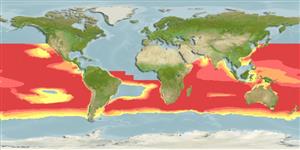
Circumglobal: In subtropical to temperate waters. Southeast Atlantic: near Ascension Island, east of Fernando de Noronha Island, and west of Cape of Good Hope, South Africa. Indian Ocean: Madagascar to Western Australia. North Pacific: Midway Islands, Hawaiian Islands to off California, USA. South Pacific: between New Zealand, Phoenix Island and southern Chile.
Longueur à la première maturité / Taille / Poids / Âge
Maturité: Lm 22.5, range 22 - 23 cm
Max length : 30.5 cm TL mâle / non sexé; (Ref. 96339)
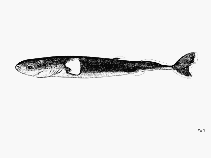
Épines dorsales (Total) : 0; Épines anales: 0. Small dogfish with a cigar-shaped body, a distinct dark collar marking around the gill region, a conical snout, large round eyes (Ref. 5578), fleshy lips, enlarged triangular lower teeth, equal-sized gill slits (Ref. 5578), very small dorsal fins, and a paddle-shaped caudal fin with nearly symmetrical upper and lower lobes (Ref. 6871). Black with white fin edges; belly luminous (Ref. 247).
Body shape (shape guide): elongated.
Epi-, meso-, and perhaps bathypelagic at 1->400 m (Ref. 58302). Occurs at or near the surface at night, descending to below 400 m (possibly as deep as 1,800 m) during the day (Ref. 31367). Feeds on squid, bony fishes, and crustaceans (Ref. 5578). Ovoviviparous (Ref. 205), with 8 young per litter, size at birth between 6 and 10 cm (Ref. 247). Caught with dip-nets and buckets at night (Ref. 6577).
Cycle de vie et comportement reproducteur
Maturité | Reproduction | Frai | Œufs | Fécondité | Larves
Ovoviviparous, with 8 young per litter. Size at birth between 6 and 10 cm (Ref. 247). Distinct pairing with embrace (Ref. 205).
Compagno, L.J.V., 1984. FAO Species Catalogue. Vol. 4. Sharks of the world. An annotated and illustrated catalogue of shark species known to date. Part 1 - Hexanchiformes to Lamniformes. FAO Fish. Synop. 125(4/1):1-249. Rome, FAO. (Ref. 247)
Statut dans la liste rouge de l'IUCN (Ref. 130435: Version 2025-2 (Global))
Menace pour l'homme
Harmless
Utilisations par l'homme
Pêcheries: sans intérêt
Outils
Articles particuliers
Télécharger en XML
Sources Internet
Estimations basées sur des modèles
Température préférée (Réf.
123201): 5.7 - 15.3, mean 9.2 °C (based on 870 cells).
Indice de diversité phylogénétique (Réf.
82804): PD
50 = 1.0010 [Uniqueness, from 0.5 = low to 2.0 = high].
Bayesian length-weight: a=0.00309 (0.00143 - 0.00669), b=3.14 (2.94 - 3.34), in cm total length, based on LWR estimates for this (Sub)family-body shape (Ref.
93245).
Niveau trophique (Réf.
69278): 4.1 ±0.4 se; based on diet studies.
Résilience (Réf.
120179): Très faible, temps minimum de doublement de population supérieur à 14 ans (Fec=8).
Vulnérabilité de la pêche (Ref.
59153): Low vulnerability (21 of 100).
🛈