Ikan bertulang rawan (sharks and rays) >
Squaliformes (Sleeper and dogfish sharks) >
Dalatiidae (Sleeper sharks)
Etymology: Euprotomicrus: eu-, a Greek intensive (i.e., very); protos (Gr.), first; mikros (Gr.), small, referring to very small first dorsal fin (See ETYFish); bispinatus: bi-, from bis (L.), two; spinatus (L.) thorny, referring to spiny processes on each pelvic fin (claspers) of the male (See ETYFish).
More on authors: Quoy & Gaimard.
Lingkungan: lingkungan / zona iklim / kisaran kedalaman / jangkauan distribusi
Ekologi
laut batipelagis; kisaran kedalaman 0 - 1800 m (Ref. 31367). Deep-water; 38°N - 54°S
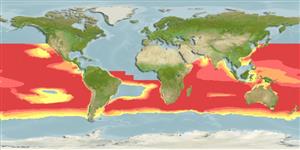
Circumglobal: In subtropical to temperate waters. Southeast Atlantic: near Ascension Island, east of Fernando de Noronha Island, and west of Cape of Good Hope, South Africa. Indian Ocean: Madagascar to Western Australia. North Pacific: Midway Islands, Hawaiian Islands to off California, USA. South Pacific: between New Zealand, Phoenix Island and southern Chile.
Panjang pada saat jatuh tempo pertama / Ukuran / Berat / umur
Kematangan: Lm 22.5, range 22 - 23 cm
Max length : 30.5 cm TL jantan/; (Ref. 96339)
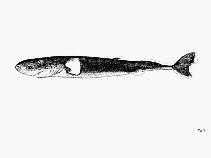
Duri punggung (Keseluruhan (total)) : 0; Duri dubur: 0. Small dogfish with a cigar-shaped body, a distinct dark collar marking around the gill region, a conical snout, large round eyes (Ref. 5578), fleshy lips, enlarged triangular lower teeth, equal-sized gill slits (Ref. 5578), very small dorsal fins, and a paddle-shaped caudal fin with nearly symmetrical upper and lower lobes (Ref. 6871). Black with white fin edges; belly luminous (Ref. 247).
Body shape (shape guide): elongated.
Epi-, meso-, and perhaps bathypelagic at 1->400 m (Ref. 58302). Occurs at or near the surface at night, descending to below 400 m (possibly as deep as 1,800 m) during the day (Ref. 31367). Feeds on squid, bony fishes, and crustaceans (Ref. 5578). Ovoviviparous (Ref. 205), with 8 young per litter, size at birth between 6 and 10 cm (Ref. 247). Caught with dip-nets and buckets at night (Ref. 6577).
Ovoviviparous, with 8 young per litter. Size at birth between 6 and 10 cm (Ref. 247). Distinct pairing with embrace (Ref. 205).
Compagno, L.J.V., 1984. FAO Species Catalogue. Vol. 4. Sharks of the world. An annotated and illustrated catalogue of shark species known to date. Part 1 - Hexanchiformes to Lamniformes. FAO Fish. Synop. 125(4/1):1-249. Rome, FAO. (Ref. 247)
Status IUCN Red List (Ref. 130435: Version 2025-2 (Global))
ancaman kepada manusia
Harmless
penggunaan manusia
Perikanan: tidak ada kepentingan
Alat, peralatan
laporan khas
muat turun XML
Sumber internet
Estimasi berdasarkan model
Suhu yang disukai (Acuan
123201): 5.7 - 15.3, mean 9.2 °C (based on 870 cells).
Indeks keanekaragaman filogenetik (Acuan
82804): PD
50 = 1.0010 [Uniqueness, from 0.5 = low to 2.0 = high].
Bayesian length-weight: a=0.00309 (0.00143 - 0.00669), b=3.14 (2.94 - 3.34), in cm total length, based on LWR estimates for this (Sub)family-body shape (Ref.
93245).
Tingkat Trofik (Acuan
69278): 4.1 ±0.4 se; based on diet studies.
Daya lenting (Acuan
120179): sangat rendah, Waktu penggandaan populasi minimum lebih dari 14 tahun (Fec=8).
Kerentanan Penangkapan Ikan (Ref.
59153): Low vulnerability (21 of 100).
🛈