>
Cichliformes (Cichlids, convict blennies) >
Cichlidae (Cichlids) > Pseudocrenilabrinae
Etymology: Hemichromis: Greek, hemis = half + Greek, chromis = a fish, perhaps a perch (Ref. 45335).
More on author: Steindachner.
Ambiente: milieu / zona climatica / distribuzione batimetrica / gamma di distribuzione
Ecologia
; acqua dolce benthopelagico. Tropical
Africa: Cuanza River in Angola (Ref. 120641, 123791, 128620),; also in Zambezi River and Okavango system (Ref. 128620)..
Dimensione / Peso / Età
Maturità: Lm ? range ? - ? cm
Max length : 10.9 cm SL maschio/sesso non determinato; (Ref. 128620)
Breve descrizione
Chiavi di identificazione | Morfologia | Morfometria
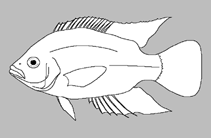
Spine dorsali (totale) : 13 - 15; Raggi dorsali molli (totale) : 10 - 12; Spine anali: 3; Raggi anali molli: 9 - 11. Diagnosis: Hemichromis angolensis can be distinguished from H. fasciatus by the absence of small black dots between the first three dark stripes on the flanks of the body of adults in most populations of H. fasciatus; it can further be distinguished from H. fasciatus by a combination of overlapping morphometrics, mainly by a high number of anal fin soft rays, 9-11 vs. 8-10; a greater body depth, 30.3-42.4% of standard length vs. 27.1-37.8%; a greater head depth, 51.4-70.6% of head length vs. 48.4-66.0%; and shorter length of lower jaw, 35.4-45.7% of head length vs. 40.0-49.0% (Ref. 128620). Hemichromis angolensis can be distinguished from H. camerounensis by a combination of overlapping morphometrics, mainly by a greater prepelvic distance, 39.0-52.0% of standard length vs. 37.6-48.5%; a shorter length of anal fin base, 13.2-17.7% of standard length vs. 14.5-18.3%; and greater preorbital distance, 10.3-18.1% of head length vs. 9.1-13.2% (Ref. 128620). Hemichromis angolensis can be distinguished from H. elongatus by a combination of overlapping morphometrics, mainly by a shorter head length, 33.6-39.7% of standard length vs. 36.9-40.2%; a shorter length of anal fin base, 13.2-17.7% of standard length vs. 14.8-22.8%; greater eye orbit diameter, 19.8-31.0% of head length vs. 18.8-28.8%; and shorter length of lower jaw, 35.4-45.7% of head length vs. 38.9-46.2% (Ref. 128620).
Ciclo vitale e comportamento di accoppiamento
Maturità | Riproduzione | Deposizione | Uova | Fecondità | Larve
Lamboj, A. and S. Koblmüller, 2022. Molecular phylogeny and taxonomic revision of the cichlid genus Hemichromis (Teleostei, Cichliformes, Cichlidae), with description of a new genus and revalidation of H. angolensis. Hydrobiologia (2022):1-22. (Ref. 128620)
Stato della Lista Rossa IUCN (Ref. 130435: Version 2025-2 (Global))
Minaccia per l'uomo
Harmless
Usi umani
Strumenti
Rapporti speciali
Scarica XML
Fonti Internet
Stime basate su modelli
Indice di diversità filogenetica (Fonte Biblio.
82804): PD
50 = 0.5625 [Uniqueness, from 0.5 = low to 2.0 = high].
Bayesian length-weight: a=0.00389 (0.00180 - 0.00842), b=3.12 (2.94 - 3.30), in cm total length, based on all LWR estimates for this body shape (Ref.
93245).
Livello trofico (Fonte Biblio.
69278): 3.3 ±0.5 se; based on size and trophs of closest relatives
Resilienza (Fonte Biblio.
120179): Alto, tempo minimo di raddoppiamento della popolazione meno di 15 mesi (Preliminary K or Fecundity.).
Vulnerabilità della pesca (Ref.
59153): Low vulnerability (10 of 100).
🛈