>
Cichliformes (Cichlids, convict blennies) >
Cichlidae (Cichlids) > Pseudocrenilabrinae
Etymology: Hemichromis: Greek, hemis = half + Greek, chromis = a fish, perhaps a perch (Ref. 45335).
More on author: Steindachner.
Environnement : milieu / zone climatique / profondeur / gamme de distribution
Écologie
; eau douce benthopélagique. Tropical
Africa: Cuanza River in Angola (Ref. 120641, 123791, 128620),; also in Zambezi River and Okavango system (Ref. 128620)..
Taille / Poids / Âge
Maturité: Lm ? range ? - ? cm
Max length : 10.9 cm SL mâle / non sexé; (Ref. 128620)
Description synthétique
Clés d'identification | Morphologie | Morphométrie
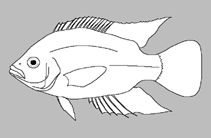
Épines dorsales (Total) : 13 - 15; Rayons mous dorsaux (Total) : 10 - 12; Épines anales: 3; Rayons mous anaux: 9 - 11. Diagnosis: Hemichromis angolensis can be distinguished from H. fasciatus by the absence of small black dots between the first three dark stripes on the flanks of the body of adults in most populations of H. fasciatus; it can further be distinguished from H. fasciatus by a combination of overlapping morphometrics, mainly by a high number of anal fin soft rays, 9-11 vs. 8-10; a greater body depth, 30.3-42.4% of standard length vs. 27.1-37.8%; a greater head depth, 51.4-70.6% of head length vs. 48.4-66.0%; and shorter length of lower jaw, 35.4-45.7% of head length vs. 40.0-49.0% (Ref. 128620). Hemichromis angolensis can be distinguished from H. camerounensis by a combination of overlapping morphometrics, mainly by a greater prepelvic distance, 39.0-52.0% of standard length vs. 37.6-48.5%; a shorter length of anal fin base, 13.2-17.7% of standard length vs. 14.5-18.3%; and greater preorbital distance, 10.3-18.1% of head length vs. 9.1-13.2% (Ref. 128620). Hemichromis angolensis can be distinguished from H. elongatus by a combination of overlapping morphometrics, mainly by a shorter head length, 33.6-39.7% of standard length vs. 36.9-40.2%; a shorter length of anal fin base, 13.2-17.7% of standard length vs. 14.8-22.8%; greater eye orbit diameter, 19.8-31.0% of head length vs. 18.8-28.8%; and shorter length of lower jaw, 35.4-45.7% of head length vs. 38.9-46.2% (Ref. 128620).
Cycle de vie et comportement reproducteur
Maturité | Reproduction | Frai | Œufs | Fécondité | Larves
Lamboj, A. and S. Koblmüller, 2022. Molecular phylogeny and taxonomic revision of the cichlid genus Hemichromis (Teleostei, Cichliformes, Cichlidae), with description of a new genus and revalidation of H. angolensis. Hydrobiologia (2022):1-22. (Ref. 128620)
Statut dans la liste rouge de l'IUCN (Ref. 130435: Version 2025-2 (Global))
Menace pour l'homme
Harmless
Utilisations par l'homme
Outils
Articles particuliers
Télécharger en XML
Sources Internet
Estimations basées sur des modèles
Indice de diversité phylogénétique (Réf.
82804): PD
50 = 0.5625 [Uniqueness, from 0.5 = low to 2.0 = high].
Bayesian length-weight: a=0.00389 (0.00180 - 0.00842), b=3.12 (2.94 - 3.30), in cm total length, based on all LWR estimates for this body shape (Ref.
93245).
Niveau trophique (Réf.
69278): 3.3 ±0.5 se; based on size and trophs of closest relatives
Résilience (Réf.
120179): Haut, temps minimum de doublement de population inférieur à 15 mois (Preliminary K or Fecundity.).
Vulnérabilité de la pêche (Ref.
59153): Low vulnerability (10 of 100).
🛈