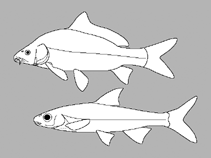
Classificazione / Nomi
Nomi Comuni | Sinonimi | Catalog of Fishes(Genere, Specie) | ITIS | CoL | WoRMS | Cloffa
>
Cypriniformes (Carps) >
Cyprinidae (Minnows or carps) > Labeoninae
Etymology: Garra: Name based on a vernacular Indian name (Hamilton, 1822:343, Ref. 1813); a fish living in mud (Ref. 128817); sannarensis: Named after "Sannar", alternative spelling of Sennar or Sinnar, the city where the species was found (Ref. 122047).
Ambiente: milieu / zona climatica / distribuzione batimetrica / gamma di distribuzione
Ecologia
; acqua dolce benthopelagico. Tropical
Africa: Sennar dam at Blue Nile River in Sudan (Ref. 122047).
Dimensione / Peso / Età
Maturità: Lm ? range ? - ? cm
Max length : 3.6 cm SL maschio/sesso non determinato; (Ref. 122047)
Breve descrizione
Chiavi di identificazione | Morfologia | Morfometria
Spine dorsali (totale) : 0; Raggi dorsali molli (totale) : 9 - 10; Spine anali: 0; Raggi anali molli: 7 - 8; Vertebre: 34 - 36. Diagnosis: From all other African Garra species except of G. napata, G. sannarensis is distinguished by: its intermediate developed sucking disc, type B, vs. fully developed disc of type C in G. blanfordii, G. chebera, G. congoensis, G. ethelwynnae, G. hindii, G. ingestii, G. makiensis, G. ornata, G. quadrimaculata, G. trewavasae, G. vinciguerrae and G. jamila, and weakly developed disc of type A in G. allostoma, G. dembecha, G. dembeensis, G. duobarbis, G. regressus and G. tana; and the absence of predorsal scales vs. presence of at least some predorsal scales in G. aethiopica, G. blanfordii, G. chebera, G. congoensis, G. dembecha, G. geba, G. hindii, G. ignestii, G. lancrenonensis, G. makiensis, G. ornata, G. quadrimaculata, G. regressus, G. tana, G. trewavasae, G. waterloti and G. vinciguerrae (Ref. 122047). Garra sannarensis is distinguished from all other species of the Main Nile basin by a caudally pointed lateroposterior flap of disc vs. rounded or absent; furthermore from G. vinciguerrae by moderately sized rostral cap and densely papillated area towards mouth vs. very prominent rostral cap with fringed but smooth posterior margin, lower-lip pad quadrangular vs. round; from G. napata and G. jamila by dorsal parts of flanks continuously covered with scales vs. naked dorsolateral flanks along anterior part dorsal fin base, and further from G. napata by its slender head and inconspicuous cheeks which are not or hardly visible when viewed from above vs. broad head and visible cheeks when viewed from above (Ref. 122047). It is distinguished from G. sp. "White Nile" by its very short barbels, which do not reach the pad when bent inwards vs. barbels nearly touching each other when flexed midways (Ref. 122047).
Body shape (shape guide): elongated.
Ciclo vitale e comportamento di accoppiamento
Maturità | Riproduzione | Deposizione | Uova | Fecondità | Larve
Moritz, T., N. Straube and D. Neumann, 2019. The Garra species (Cyprinidae) of the Main Nile basin with description of three new species. Cybium 43(4):311-329. (Ref. 122047)
Stato della Lista Rossa IUCN (Ref. 130435: Version 2025-2 (Global))
Minaccia per l'uomo
Harmless
Usi umani
Pesca: di nessun interesse
Strumenti
Rapporti speciali
Scarica XML
Fonti Internet
Stime basate su modelli
Indice di diversità filogenetica (Fonte Biblio.
82804): PD
50 = 0.5000 [Uniqueness, from 0.5 = low to 2.0 = high].
Bayesian length-weight: a=0.00794 (0.00359 - 0.01758), b=3.04 (2.87 - 3.21), in cm total length, based on LWR estimates for this Genus-body shape (Ref.
93245).
Resilienza (Fonte Biblio.
120179): Alto, tempo minimo di raddoppiamento della popolazione meno di 15 mesi (Preliminary K or Fecundity.).
Vulnerabilità della pesca (Ref.
59153): Low vulnerability (10 of 100).
🛈