Classification / Noms
Noms communs | Synonymes | Catalog of Fishes(Genre, Espèce) | ITIS | CoL | WoRMS | Cloffa
>
Cypriniformes (Carps) >
Cyprinidae (Minnows or carps) > Labeoninae
Etymology: Garra: Name based on a vernacular Indian name (Hamilton, 1822:343, Ref. 1813); a fish living in mud (Ref. 128817); sannarensis: Named after "Sannar", alternative spelling of Sennar or Sinnar, the city where the species was found (Ref. 122047).
Environnement : milieu / zone climatique / profondeur / gamme de distribution
Écologie
; eau douce benthopélagique. Tropical
Africa: Sennar dam at Blue Nile River in Sudan (Ref. 122047).
Taille / Poids / Âge
Maturité: Lm ? range ? - ? cm
Max length : 3.6 cm SL mâle / non sexé; (Ref. 122047)
Description synthétique
Clés d'identification | Morphologie | Morphométrie
Épines dorsales (Total) : 0; Rayons mous dorsaux (Total) : 9 - 10; Épines anales: 0; Rayons mous anaux: 7 - 8; Vertèbres: 34 - 36. Diagnosis: From all other African Garra species except of G. napata, G. sannarensis is distinguished by: its intermediate developed sucking disc, type B, vs. fully developed disc of type C in G. blanfordii, G. chebera, G. congoensis, G. ethelwynnae, G. hindii, G. ingestii, G. makiensis, G. ornata, G. quadrimaculata, G. trewavasae, G. vinciguerrae and G. jamila, and weakly developed disc of type A in G. allostoma, G. dembecha, G. dembeensis, G. duobarbis, G. regressus and G. tana; and the absence of predorsal scales vs. presence of at least some predorsal scales in G. aethiopica, G. blanfordii, G. chebera, G. congoensis, G. dembecha, G. geba, G. hindii, G. ignestii, G. lancrenonensis, G. makiensis, G. ornata, G. quadrimaculata, G. regressus, G. tana, G. trewavasae, G. waterloti and G. vinciguerrae (Ref. 122047). Garra sannarensis is distinguished from all other species of the Main Nile basin by a caudally pointed lateroposterior flap of disc vs. rounded or absent; furthermore from G. vinciguerrae by moderately sized rostral cap and densely papillated area towards mouth vs. very prominent rostral cap with fringed but smooth posterior margin, lower-lip pad quadrangular vs. round; from G. napata and G. jamila by dorsal parts of flanks continuously covered with scales vs. naked dorsolateral flanks along anterior part dorsal fin base, and further from G. napata by its slender head and inconspicuous cheeks which are not or hardly visible when viewed from above vs. broad head and visible cheeks when viewed from above (Ref. 122047). It is distinguished from G. sp. "White Nile" by its very short barbels, which do not reach the pad when bent inwards vs. barbels nearly touching each other when flexed midways (Ref. 122047).
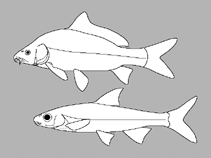
Body shape (shape guide): elongated.
Cycle de vie et comportement reproducteur
Maturité | Reproduction | Frai | Œufs | Fécondité | Larves
Moritz, T., N. Straube and D. Neumann, 2019. The Garra species (Cyprinidae) of the Main Nile basin with description of three new species. Cybium 43(4):311-329. (Ref. 122047)
Statut dans la liste rouge de l'IUCN (Ref. 130435: Version 2025-2 (Global))
Menace pour l'homme
Harmless
Utilisations par l'homme
Pêcheries: sans intérêt
Outils
Articles particuliers
Télécharger en XML
Sources Internet
Estimations basées sur des modèles
Indice de diversité phylogénétique (Réf.
82804): PD
50 = 0.5000 [Uniqueness, from 0.5 = low to 2.0 = high].
Bayesian length-weight: a=0.00794 (0.00359 - 0.01758), b=3.04 (2.87 - 3.21), in cm total length, based on LWR estimates for this Genus-body shape (Ref.
93245).
Résilience (Réf.
120179): Haut, temps minimum de doublement de population inférieur à 15 mois (Preliminary K or Fecundity.).
Vulnérabilité de la pêche (Ref.
59153): Low vulnerability (10 of 100).
🛈