Classification / Noms
Noms communs | Synonymes | Catalog of Fishes(Genre, Espèce) | ITIS | CoL | WoRMS | Cloffa
>
Cypriniformes (Carps) >
Cyprinidae (Minnows or carps) > Labeoninae
Etymology: Garra: Name based on a vernacular Indian name (Hamilton, 1822:343, Ref. 1813); a fish living in mud (Ref. 128817).
Environnement : milieu / zone climatique / profondeur / gamme de distribution
Écologie
; eau douce benthopélagique. Tropical
Africa: Nile River in Sudan and Egypt (Ref. 122047).
Taille / Poids / Âge
Maturité: Lm ? range ? - ? cm
Max length : 12.2 cm SL mâle / non sexé; (Ref. 122047)
Description synthétique
Clés d'identification | Morphologie | Morphométrie
Épines dorsales (Total) : 0; Rayons mous dorsaux (Total) : 9 - 12; Épines anales: 0; Rayons mous anaux: 7 - 8; Vertèbres: 34 - 37. Diagnosis: Garra vinciguerra is distinguished from other African Garra species by: its well-developed sucking disc of type C vs. A or B in G. aethiopica, G. allostoma, G. dembecha, G. dembeensis, G. duobarbis, G. lancrenonensis, G. regressus, G. tana, G. napata and G. sannarensis; by its partly scaled predorsal area vs. fully scaled in G. aethiopica, G. blanfordii, G. chebera, G. congoensis, G. hindi, G. ignestii, G. makiensis and G. quadrimaculata, or predorsal scales absent in G. duobarbis, G. ethelwynnae, G. napata, G. sannarensis and G. jamila (Ref. 122047). It is distinguished from G. geba by its scaled postpelvic area vs. asquamate, from G. ornata by its asquamate belly vs. scaled, from G. trewavasae by only 3-3.5 scales between lateral line and pelvic fin vs. 4.5, and from G. waterloti from the upper Niger and upper Senegal rivers by the absence of a marked dark lateral band along the flank vs. present (Ref. 122047). Inside the entire Nile basin, overall similar to G. dembeensis and G. blanfordii, but distinguished from G. dembeensis by the scaled postpelvic area vs. asquamate and by an increased number of predorsal scales, 5-9 vs. 0-4; from G. blanfordii by having a large scaleless predorsal area vs. fully scaled, corresponding to 15 predorsal scales, and in the densely scaled postpelvic area vs. asquamate (Ref. 122047). Garra vinciguerrae differs from all other Garra species in the Main Nile basin in the presence of at least few irregular predorsal scales vs. predorsal scales always absent, a scaled postpelvic area vs. asquamate, and moreover from G. jamila and G. napata by absence of a dark median band in the dorsal fin vs. presence, and 4.4-5 scale rows between the origin of dorsal fin and the pored lateral line vs. 2-2.5; from G. sannarensis by the divergent disc morphology including a very large and prominently fringed upper lip vs. moderately sized and usually densely papillated, an equally shaped and posteriorly rounded lateroposterior flap vs. medial enlarged posteriorly pointing flap; pad round vs. quadrangular; and from Garra sp. 'White Nile' by the presence of only minute posterior barbels not reaching pad of disc when folded medially vs. almost reaching each other when flexed inwards (Ref. 122047).
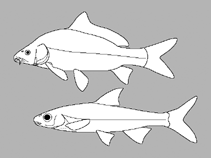
Body shape (shape guide): elongated.
Apparently restricted to fast flowing stretches in the cataracts of the Nile River below Khartoum (Ref. 122047).
Cycle de vie et comportement reproducteur
Maturité | Reproduction | Frai | Œufs | Fécondité | Larves
Moritz, T., N. Straube and D. Neumann, 2019. The Garra species (Cyprinidae) of the Main Nile basin with description of three new species. Cybium 43(4):311-329. (Ref. 122047)
Statut dans la liste rouge de l'IUCN (Ref. 130435: Version 2025-2 (Global))
Menace pour l'homme
Harmless
Utilisations par l'homme
Pêcheries: sans intérêt
Outils
Articles particuliers
Télécharger en XML
Sources Internet
Estimations basées sur des modèles
Indice de diversité phylogénétique (Réf.
82804): PD
50 = 0.5000 [Uniqueness, from 0.5 = low to 2.0 = high].
Bayesian length-weight: a=0.00794 (0.00359 - 0.01758), b=3.04 (2.87 - 3.21), in cm total length, based on LWR estimates for this Genus-body shape (Ref.
93245).
Résilience (Réf.
120179): Haut, temps minimum de doublement de population inférieur à 15 mois (Preliminary K or Fecundity.).
Vulnérabilité de la pêche (Ref.
59153): Low vulnerability (10 of 100).
🛈