klasifikasi / Nama
Nama-nama umum | Sinonim (persamaan) | Catalog of Fishes(Marga, Jenis) | ITIS | CoL | WoRMS | Cloffa
>
Cypriniformes (Carps) >
Cyprinidae (Minnows or carps) > Labeoninae
Etymology: Garra: Name based on a vernacular Indian name (Hamilton, 1822:343, Ref. 1813); a fish living in mud (Ref. 128817).
Lingkungan: lingkungan / zona iklim / kisaran kedalaman / jangkauan distribusi
Ekologi
; air tawar bentopelagis. Tropical
Africa: Nile River in Sudan and Egypt (Ref. 122047).
Ukuran / Berat / umur
Kematangan: Lm ? range ? - ? cm
Max length : 12.2 cm SL jantan/; (Ref. 122047)
deskripsi pendek
Kunci identifiaksi (pengenalan) | Morfologi | Morfometrik
Duri punggung (Keseluruhan (total)) : 0; duri punggung lunak (Keseluruhan (total)) : 9 - 12; Duri dubur: 0; Sirip dubur lunak: 7 - 8; vertebrata, bertulang belakang: 34 - 37. Diagnosis: Garra vinciguerra is distinguished from other African Garra species by: its well-developed sucking disc of type C vs. A or B in G. aethiopica, G. allostoma, G. dembecha, G. dembeensis, G. duobarbis, G. lancrenonensis, G. regressus, G. tana, G. napata and G. sannarensis; by its partly scaled predorsal area vs. fully scaled in G. aethiopica, G. blanfordii, G. chebera, G. congoensis, G. hindi, G. ignestii, G. makiensis and G. quadrimaculata, or predorsal scales absent in G. duobarbis, G. ethelwynnae, G. napata, G. sannarensis and G. jamila (Ref. 122047). It is distinguished from G. geba by its scaled postpelvic area vs. asquamate, from G. ornata by its asquamate belly vs. scaled, from G. trewavasae by only 3-3.5 scales between lateral line and pelvic fin vs. 4.5, and from G. waterloti from the upper Niger and upper Senegal rivers by the absence of a marked dark lateral band along the flank vs. present (Ref. 122047). Inside the entire Nile basin, overall similar to G. dembeensis and G. blanfordii, but distinguished from G. dembeensis by the scaled postpelvic area vs. asquamate and by an increased number of predorsal scales, 5-9 vs. 0-4; from G. blanfordii by having a large scaleless predorsal area vs. fully scaled, corresponding to 15 predorsal scales, and in the densely scaled postpelvic area vs. asquamate (Ref. 122047). Garra vinciguerrae differs from all other Garra species in the Main Nile basin in the presence of at least few irregular predorsal scales vs. predorsal scales always absent, a scaled postpelvic area vs. asquamate, and moreover from G. jamila and G. napata by absence of a dark median band in the dorsal fin vs. presence, and 4.4-5 scale rows between the origin of dorsal fin and the pored lateral line vs. 2-2.5; from G. sannarensis by the divergent disc morphology including a very large and prominently fringed upper lip vs. moderately sized and usually densely papillated, an equally shaped and posteriorly rounded lateroposterior flap vs. medial enlarged posteriorly pointing flap; pad round vs. quadrangular; and from Garra sp. 'White Nile' by the presence of only minute posterior barbels not reaching pad of disc when folded medially vs. almost reaching each other when flexed inwards (Ref. 122047).
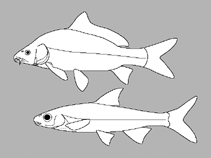
Body shape (shape guide): elongated.
Apparently restricted to fast flowing stretches in the cataracts of the Nile River below Khartoum (Ref. 122047).
Siklus hidup dan perilaku kawin
Kematangan | Reproduksi, perkembang biakan | Pemijahan | telur-telur | Fekunditas | Larva
Moritz, T., N. Straube and D. Neumann, 2019. The Garra species (Cyprinidae) of the Main Nile basin with description of three new species. Cybium 43(4):311-329. (Ref. 122047)
Status IUCN Red List (Ref. 130435: Version 2025-2 (Global))
ancaman kepada manusia
Harmless
penggunaan manusia
Perikanan: tidak ada kepentingan
Alat, peralatan
laporan khas
muat turun XML
Sumber internet
Estimasi berdasarkan model
Indeks keanekaragaman filogenetik (Acuan
82804): PD
50 = 0.5000 [Uniqueness, from 0.5 = low to 2.0 = high].
Bayesian length-weight: a=0.00794 (0.00359 - 0.01758), b=3.04 (2.87 - 3.21), in cm total length, based on LWR estimates for this Genus-body shape (Ref.
93245).
Daya lenting (Acuan
120179): Tinggi, Waktu penggandaan populasi minimum kurang dari 15 bulan (Preliminary K or Fecundity.).
Kerentanan Penangkapan Ikan (Ref.
59153): Low vulnerability (10 of 100).
🛈