Clasificación / Nombres
Nombres comunes | Sinónimos | Catalog of Fishes(Género, Especie) | ITIS | CoL | WoRMS | Cloffa
>
Atheriniformes (Silversides) >
Melanotaeniidae (Rainbowfishes, blue eyes)
Etymology: Melanotaenia: Greek, melan, -anos = black + latin, taenia = stripe (Ref. 45335); flavipinnis: Named flavipinnis (latin: yellow fin) with reference to the yellow colour of the dorsal, anal, and pelvic fins (Ref. 094793).
Entorno: milieu / zona climática / rango de profundidad / gama de distribución
Ecología
; agua dulce bentopelágico. Tropical
Asia: Indonsesia; known only from the southeastern portion of the island of Misool in two drainage systems, Garn River and Ifaupan Creek (Ref. 094793).
Tamaño / Peso / Edad
Madurez: Lm ? range ? - ? cm
Max length : 7.2 cm SL macho / no sexado; (Ref. 94793); 7.7 cm SL (female)
Descripción breve
Claves de identificación | Morfología | Morfometría
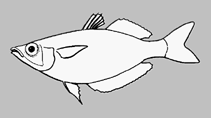
Espinas dorsales (total) : 4 - 6; Radios blandos dorsales (total) : 11 - 14; Radios blandos anales: 22 - 26. Diagnosis: distinguished by the following combination of characters: dorsal rays usually V or VI-I, 11 to 14 (usually 13); anal-rays I,22-26 (usually 23 to 25); pectoral-rays 12 to 14 ( usually 14); lateral scales 34-36 (usually 35 or 36), predorsal scales 16 to 19 (usually 17 or 18); circumpeduncular scales 12 or 13; total gill rakers on 1st arch 16 to 19 ( usually 18 or 19); total scales covering preoperculum 11-16 (average 13.2); origin of 1st dorsal-fin clearly anterior to anal-fin origin; longest anal-fin ray conspicuously greater than caudal peduncle depth; greatest body depth of adult male relatively slender, 2.8-3.3 in SL; colour in life generally greenish dorsally with faint yellow stripe between each horizontal scale row; prominent midlateral blue stripe on posterior half of body, initially one scale row in width, but expanding to 2 rows (midlateral and row just below) on caudal peduncle; median fins generally yellow, except caudal fin greyish brown (Ref. 094793).
Body shape (shape guide): fusiform / normal; Cross section: compressed.
Ciclo vital y comportamiento de apareamiento
Madurez | Reproducción | Puesta | Huevos | Fecundidad | Larva
Allen, G.R., R.K. Hadiaty and P.J. Unmack, 2014. Melanotaenia flavipinnis, a new species of Rainbowfish (Melanotaeniidae) fromm Misool Island, West Papua Province, Indonesia. aqua, Int. J. Ichthyol. 20(1):35-52. (Ref. 94793)
Situación en la Lista Roja de la UICN (Ref. 130435: Version 2025-2 (Global))
Amenaza para el ser humano
Harmless
Usos humanos
Pesquerías: de interés potencial; Acuario: Potencial
Herramientas
Informes especiales
Descargar XML
Fuentes de Internet
Estimaciones basadas en modelos
Índice de diversidad filogenética (Referencia
82804): PD
50 = 0.5000 [Uniqueness, from 0.5 = low to 2.0 = high].
Bayesian length-weight: a=0.01122 (0.00514 - 0.02450), b=3.04 (2.87 - 3.21), in cm total length, based on all LWR estimates for this body shape (Ref.
93245).
Nivel trófico (Referencia
69278): 2.9 ±0.4 se; based on size and trophs of closest relatives
Resiliencia (Referencia
120179): Medio, población duplicada en un tiempo mínimo de 1.4-4.4 años (Preliminary K or Fecundity.).
Vulnerabilidad pesquera (Ref.
59153): Low vulnerability (10 of 100).
🛈