Classification / Noms
Noms communs | Synonymes | Catalog of Fishes(Genre, Espèce) | ITIS | CoL | WoRMS | Cloffa
>
Atheriniformes (Silversides) >
Melanotaeniidae (Rainbowfishes, blue eyes)
Etymology: Melanotaenia: Greek, melan, -anos = black + latin, taenia = stripe (Ref. 45335); flavipinnis: Named flavipinnis (latin: yellow fin) with reference to the yellow colour of the dorsal, anal, and pelvic fins (Ref. 094793).
Environnement : milieu / zone climatique / profondeur / gamme de distribution
Écologie
; eau douce benthopélagique. Tropical
Asia: Indonsesia; known only from the southeastern portion of the island of Misool in two drainage systems, Garn River and Ifaupan Creek (Ref. 094793).
Taille / Poids / Âge
Maturité: Lm ? range ? - ? cm
Max length : 7.2 cm SL mâle / non sexé; (Ref. 94793); 7.7 cm SL (female)
Description synthétique
Clés d'identification | Morphologie | Morphométrie
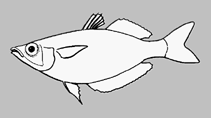
Épines dorsales (Total) : 4 - 6; Rayons mous dorsaux (Total) : 11 - 14; Rayons mous anaux: 22 - 26. Diagnosis: distinguished by the following combination of characters: dorsal rays usually V or VI-I, 11 to 14 (usually 13); anal-rays I,22-26 (usually 23 to 25); pectoral-rays 12 to 14 ( usually 14); lateral scales 34-36 (usually 35 or 36), predorsal scales 16 to 19 (usually 17 or 18); circumpeduncular scales 12 or 13; total gill rakers on 1st arch 16 to 19 ( usually 18 or 19); total scales covering preoperculum 11-16 (average 13.2); origin of 1st dorsal-fin clearly anterior to anal-fin origin; longest anal-fin ray conspicuously greater than caudal peduncle depth; greatest body depth of adult male relatively slender, 2.8-3.3 in SL; colour in life generally greenish dorsally with faint yellow stripe between each horizontal scale row; prominent midlateral blue stripe on posterior half of body, initially one scale row in width, but expanding to 2 rows (midlateral and row just below) on caudal peduncle; median fins generally yellow, except caudal fin greyish brown (Ref. 094793).
Body shape (shape guide): fusiform / normal; Cross section: compressed.
Cycle de vie et comportement reproducteur
Maturité | Reproduction | Frai | Œufs | Fécondité | Larves
Allen, G.R., R.K. Hadiaty and P.J. Unmack, 2014. Melanotaenia flavipinnis, a new species of Rainbowfish (Melanotaeniidae) fromm Misool Island, West Papua Province, Indonesia. aqua, Int. J. Ichthyol. 20(1):35-52. (Ref. 94793)
Statut dans la liste rouge de l'IUCN (Ref. 130435: Version 2025-2 (Global))
Menace pour l'homme
Harmless
Utilisations par l'homme
Pêcheries: d'intérêt potentiel; Aquarium: potentiel
Outils
Articles particuliers
Télécharger en XML
Sources Internet
Estimations basées sur des modèles
Indice de diversité phylogénétique (Réf.
82804): PD
50 = 0.5000 [Uniqueness, from 0.5 = low to 2.0 = high].
Bayesian length-weight: a=0.01122 (0.00514 - 0.02450), b=3.04 (2.87 - 3.21), in cm total length, based on all LWR estimates for this body shape (Ref.
93245).
Niveau trophique (Réf.
69278): 2.9 ±0.4 se; based on size and trophs of closest relatives
Résilience (Réf.
120179): Milieu, temps minimum de doublement de population : 1,4 à 4,4 années (Preliminary K or Fecundity.).
Vulnérabilité de la pêche (Ref.
59153): Low vulnerability (10 of 100).
🛈