การจำแนกประเภท / ชื่อ
ชื่อสามัญ | ชื่อพ้อง | Catalog of Fishes(สกุล, ชนิด) | ITIS | CoL | WoRMS | Cloffa
>
Siluriformes (Catfishes) >
Loricariidae (Armored catfishes) > Hypostominae
Etymology: jariensis: The specific name jariensis is used in reference to the type locality, the rio Jari, a large tributary of the rio Amazon basin.
สิ่งแวดล้อม : สิ่งแวดล้อม / เขตภูมิอากาศ / ระดับความลึก / ระยะการกระจายสินค้า
นิเวศวิทยา
; น้ำจืด สัตว์น้ำหน้าดิน. Tropical
South America: Rio Jari basin in Amapá State, Brazil.
ขนาด / น้ำหนัก / อายุ
วัยเจริญพันธุ์: Lm ? range ? - ? cm
Max length : 6.1 cm SL เพศผู้/กระเทย; (Ref. 118148)
คำอธิบายสั้นๆ
เครื่องมือที่ใช้ในการแยกชนิดสัตว์,สิ่งมีชีวิตออกจากกัน | สัณฐานวิทยา | ความยาวต่างๆ
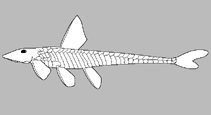
เงี่ยงครีบหลัง (รวม) : 2; ก้านครีบอ่อนที่หาง (รวม) : 7; เงี่ยงครีบก้น: 1; ก้านครีบอ่อนที่ก้น: 5. Lithoxus jariensis is distinguished from its congeners L. surinamensis and L. pallidimaculatus by having an adipose fin (vs. adipose fin absent); from L. bovallii by the lack of an irregular concentration of chromatophores around the anal-fin origin and adjacent region (vs. present), and by having three dark bands in the caudal fin (vs. five dark bands); from L. lithoides and L. jantjae by having five branched rays in the anal fin (vs. four); from L. pallidimaculatus and L. raso by the lack of light spots on the body (vs. light spots on the body present); from L. jantjae by having 14 branched rays in the caudal fin (vs. 12); and from L. stocki by having medial premaxillary teeth with an enlarged and widened cusp (vs. cusps of all premaxillary teeth similar in size, not enlarged), and 5-8 dentary teeth (vs. 10-12). In addition, Lithoxus jariensis can be diagnosed from L. boujardi by having a greater adipose-spine length, 6.2-10.1% SL (vs. 3.6-4.7% SL), and by having a greater dorsal adipose-caudal distance, 12.0-16.5% SL (vs. 10.3-11.7% SL); from L. planquettei by smaller caudal peduncle depth, 7.6-8.7% SL (vs. 9.7-10.5% SL), and by having a straight adipose-fin spine (vs. a curved adipose-fin spine); and from L. stocki by having a shorter cleithral width, 27.8-31.2% SL (vs. 32.6-34.2% SL), and a greater dorsal-anal distance, 10.4-13.7% SL (vs. 8.8-10.4% SL) (Ref. 118148).
Body shape (shape guide): elongated.
Facultative air-breathing in the genus (Ref. 126274); Inhabits the bottom of fast-flowing clear-water rivers of medium to large size. The bottom of the rivers consists of small to large rocks, loose stones, and sand (Ref. 118148).
วงจรชีวิตและพฤติกรรมการผสมพันธุ์
วัยเจริญพันธุ์ | การสืบพันธุ์ | การวางไข่ | เซลสืบพันธ์ของเพศเมีย(ไข่) | ความดกของไข่ | ตัวอ่อน
Silva, G.S.C., R. Covain, C. Oliveira and F.F. Roxo, 2017. Description of two new species of Lithoxus (Hypostominae: Loricariidae) from rio Jari and rio Amapá basins, Brazillian Guiana shield. Zootaxa 4347(1):151-168. (Ref. 118148)
สถานะบัญชีแดงของ IUCN (Ref. 130435: Version 2025-2 (Global))
ภัยคุกคามต่อมนุษย์
Harmless
การใช้ของมนุษย์
เครื่องมือ
รายงานพิเศษ
ดาวน์โหลด XML
แหล่งที่มาจากอินเตอร์เน็ต
การประมาณค่าตามแบบจำลอง
ดัชนีความหลากหลายทางวิวัฒนาการ (อ้างอิง
82804): PD
50 = 0.5039 [Uniqueness, from 0.5 = low to 2.0 = high].
Bayesian length-weight: a=0.01549 (0.00726 - 0.03306), b=2.96 (2.79 - 3.13), in cm total length, based on LWR estimates for this (Sub)family-body shape (Ref.
93245).
ความสามารถในการกลับคืนสู่ปกติ (อ้างอิง
120179): ความสูง, เวลาต่ำสุดที่จะทำให้ประชากรเพิ่มขึ้นเป็น 2 เท่าใช้เวลาน้อยกว่า 15 เดือน (Preliminary K or Fecundity.).
ความเสี่ยงต่อการตกปลา (Ref.
59153): Low vulnerability (10 of 100).
🛈