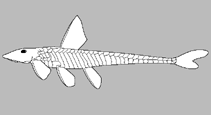
Classification / Noms
Noms communs | Synonymes | Catalog of Fishes(Genre, Espèce) | ITIS | CoL | WoRMS | Cloffa
>
Siluriformes (Catfishes) >
Loricariidae (Armored catfishes) > Hypostominae
Etymology: jariensis: The specific name jariensis is used in reference to the type locality, the rio Jari, a large tributary of the rio Amazon basin.
Environnement : milieu / zone climatique / profondeur / gamme de distribution
Écologie
; eau douce démersal. Tropical
South America: Rio Jari basin in Amapá State, Brazil.
Taille / Poids / Âge
Maturité: Lm ? range ? - ? cm
Max length : 6.1 cm SL mâle / non sexé; (Ref. 118148)
Description synthétique
Clés d'identification | Morphologie | Morphométrie
Épines dorsales (Total) : 2; Rayons mous dorsaux (Total) : 7; Épines anales: 1; Rayons mous anaux: 5. Lithoxus jariensis is distinguished from its congeners L. surinamensis and L. pallidimaculatus by having an adipose fin (vs. adipose fin absent); from L. bovallii by the lack of an irregular concentration of chromatophores around the anal-fin origin and adjacent region (vs. present), and by having three dark bands in the caudal fin (vs. five dark bands); from L. lithoides and L. jantjae by having five branched rays in the anal fin (vs. four); from L. pallidimaculatus and L. raso by the lack of light spots on the body (vs. light spots on the body present); from L. jantjae by having 14 branched rays in the caudal fin (vs. 12); and from L. stocki by having medial premaxillary teeth with an enlarged and widened cusp (vs. cusps of all premaxillary teeth similar in size, not enlarged), and 5-8 dentary teeth (vs. 10-12). In addition, Lithoxus jariensis can be diagnosed from L. boujardi by having a greater adipose-spine length, 6.2-10.1% SL (vs. 3.6-4.7% SL), and by having a greater dorsal adipose-caudal distance, 12.0-16.5% SL (vs. 10.3-11.7% SL); from L. planquettei by smaller caudal peduncle depth, 7.6-8.7% SL (vs. 9.7-10.5% SL), and by having a straight adipose-fin spine (vs. a curved adipose-fin spine); and from L. stocki by having a shorter cleithral width, 27.8-31.2% SL (vs. 32.6-34.2% SL), and a greater dorsal-anal distance, 10.4-13.7% SL (vs. 8.8-10.4% SL) (Ref. 118148).
Body shape (shape guide): elongated.
Facultative air-breathing in the genus (Ref. 126274); Inhabits the bottom of fast-flowing clear-water rivers of medium to large size. The bottom of the rivers consists of small to large rocks, loose stones, and sand (Ref. 118148).
Cycle de vie et comportement reproducteur
Maturité | Reproduction | Frai | Œufs | Fécondité | Larves
Silva, G.S.C., R. Covain, C. Oliveira and F.F. Roxo, 2017. Description of two new species of Lithoxus (Hypostominae: Loricariidae) from rio Jari and rio Amapá basins, Brazillian Guiana shield. Zootaxa 4347(1):151-168. (Ref. 118148)
Statut dans la liste rouge de l'IUCN (Ref. 130435: Version 2025-2 (Global))
Menace pour l'homme
Harmless
Utilisations par l'homme
Outils
Articles particuliers
Télécharger en XML
Sources Internet
Estimations basées sur des modèles
Indice de diversité phylogénétique (Réf.
82804): PD
50 = 0.5039 [Uniqueness, from 0.5 = low to 2.0 = high].
Bayesian length-weight: a=0.01549 (0.00726 - 0.03306), b=2.96 (2.79 - 3.13), in cm total length, based on LWR estimates for this (Sub)family-body shape (Ref.
93245).
Résilience (Réf.
120179): Haut, temps minimum de doublement de population inférieur à 15 mois (Preliminary K or Fecundity.).
Vulnérabilité de la pêche (Ref.
59153): Low vulnerability (10 of 100).
🛈