分類 / 名前
共通名の | 類義語 | Catalog of Fishes(部類, 種) | ITIS | CoL | WoRMS | Cloffa
環境:環境 / 気候帯 / 深さの範囲 / 分布範囲
生態学
; 新鮮な水 底生の漂泳性. Subtropical
South America: Paraná River and Uruguay River basins.
サイズ / 重さ / 年齢
成熟: Lm ? range ? - ? cm
Max length : 30.5 cm TL オス/雌雄の選別がない; (Ref. 118108)
簡単な記述
検索表 | 形態学 | 形態計測学
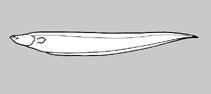
臀鰭: 141 - 259. Gymnotus cuia differs from the most similar sympatric G. c. australis by the following characters: shorter head length (8%-12.2% TL, mean 10.9% TL, vs. 11.7%-14.0% TL, mean 12.9% TL); deeper body (body depth 85.4%-133.3% HL, mean 110.6% HL vs. 67.0%-98.8% HL, mean 87.9% HL); and deeper head (head depth 61.9%-80.2% HL, mean 68.5% HL vs. 51.2%-64.6% HL, mean 59.7% HL). It can be distinguished from another similar sympatric species G. omarorum by having more anal-fin pterygiophore scales (6-10, mode 8 vs. 5-6, mode 6); more pored lateral-line scales anterior to the first ventral lateral-line ramus (32-47, mode 37 vs. 23-30, mode 27); and fewer ventral lateral-line rami (14-28, mode 22 vs. 28-30, mode 29). It further differs from all other members of the G. carapo clade in having a color patter consisting of 21-29 (mode 28) obliquely-oriented, chocolate-colored bands with wavy, irregular margins and pale interbands less than one-third width of dark bands at mid-body (vs. bands interrupted into patches anterodorsally, with silver, blue or green metallic countershading on dorsum of adults of G. arapaima, dark bands lost in large adults (>25.0 cm) of G. ardilai, small, rounded dark spots over entire body except posterior 20% of some specimens of G. bahianus, bands faint or absent in all specimens of G. chimarrao, one to three inverted Y-shaped dark bands posteriorly and pale bands not reaching above lateral line in anterior two thirds of body of G. choco, bands broken into speckles throughout in G. diamantinensis, narrow pale bands (<20% width of dark bands) with sharp margins, and pale bands extending fully to dorsal mid-line in G. mamiraua, bands faint or absent from 80% of dorsum in all specimens, and narrow pale bands (<20% width of dark bands) which never extend above lateral line on anterior half of body in G. pantanal, pale bands wider than dark bands in G. sylvius, narrow pale interbands (<33% width of dark bands) extending above lateral line and often to dorsal midline in G. ucamara. It can be further diagnosed from all members of the G. varzea clade (G. chaviro, G. curupira, G. mamiraua, G. obscurus, and G. varzea) by the following characters: relatively more arrowhead-shaped dentary teeth (6 vs. 2-4 in the G. varzea clade except in G. chaviro, G. curupira and G. mamiraua, with 4-7); anterior 80% of anal fin membrane pigmented, posterior 20% translucent (vs. wholly clear or evenly pigmented in the G. varzea clade); and large adult total length (30.5 cm TL vs. 21.5 cm-27.5 cm TL in the G. varzea clade) (Ref. 118108).
Body shape (shape guide): elongated.
Facultative air-breathing in the genus (Ref. 126274); Occurs in lakes and small streams with dense vegetation. Found in abundance in a shallow lake with depth of less than 1 m. dense emergent vegetation, and abundant grass in the shores. Usually abundant in the roots of dense beds of floating water hyacinth Eichornia crassipes throughout its range. Reproductive cycle occurs in November-March (Ref. 118108).
ライフサイクルと交尾行動
成熟 | 繁殖 | 放精 | 卵 | 生産力 | 幼生
Craig, J.M., L.R. Malabarba, W.G.R. Crampton and J.S. Albert, 2018. Revision of banded knifefishes of the Gymnotus carapo and G. tigre clades (Gymnotidae Gymnotiformes) from the Southern Neotropics. Zootaxa 4379(1):47-73. (Ref. 118108)
IUCNのレッドリストの状況は (Ref. 130435: Version 2025-2 (Global))
人間の用途
用具
特記事項
XMLをダウンロードして下さい
インターネットの情報源
モデルに基づく推定値
系統多様性指数 (参照
82804): PD
50 = 0.5000 [Uniqueness, from 0.5 = low to 2.0 = high].
Bayesian length-weight: a=0.00437 (0.00209 - 0.00911), b=2.98 (2.79 - 3.17), in cm total length, based on LWR estimates for this (Sub)family-body shape (Ref.
93245).
栄養段階 (参照
69278): 3.3 ±0.4 se; based on size and trophs of closest relatives
回復力 (参照
120179): 高い, 15か月以下の倍増期間の最小個体群 (Preliminary K or Fecundity.).
漁業の脆弱性 (Ref.
59153): Low vulnerability (21 of 100).
🛈