>
Cichliformes (Cichlids, convict blennies) >
Cichlidae (Cichlids) > Pseudocrenilabrinae
Etymology: Haplochromis: Greek, Haploos = single + Greek, chromis = a fish, perhaps a perch (Ref. 45335); taurinus: Probably refers to Latin 'taurinus', bull, presumably relating to resemblance of head morphology to that of a bull: stout with firmly thickened lips (Ref. 127594).
More on author: Trewavas.
Περιβάλλον: περιβάλλον / κλιματική ζώνη / εύρος βάθους / εύρος διανομής
Οικολογία
; Γλυκού νερού βενθοπελαγικό; μη μεταναστευτικό(ά). Tropical; 1°N - 1°S
Africa: Lakes Edward and George and Kazinga Channel (Ref. 4983, 127594).
Μέγεθος / Βάρος / Ηλικία
Γεννητική Ωρίμανση: Lm ? range ? - ? cm
Max length : 14.0 cm SL αρσενικό/απροσδιόριστο; (Ref. 4983)
Σύντομη περιγραφή
Κλείδες προσδιορισμού | Μορφολογία | Μορφομετρία
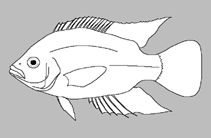
Ραχιαίες άκανθες (συνολικά) : 15 - 17; Μαλακές ραχιαίες ακτίνες (συνολικά) : 8 - 10; Εδρικές άκανθες: 3; Μαλακές εδρικές ακτίνες: 8 - 10; Σπόνδυλοι: 29 - 30. Diagnosis: Haplochromis taurinus differs from all Haplochromis species of Lake Edward system by its anteriorly curved outer teeth in the lower jaw (Ref. 127594). It is distinct from all other known paedophagous species within these lakes by its larger eyes, 32.9-40.2% of head length vs. 29.0-34.7%, and outer teeth with conical necks and bicuspid crowns with major cusps that bear a clear flange vs. cylindrical to constricted necks and uni-, bi-, or weakly tricuspid crowns that, in large specimens of more than 100 mm standard length, bear no flange (Ref. 127594). It is similar to H. molossus and H. gracilifur by its rounded jaws and small lachrymal bones; distinct from H. gracilifur by its deeper caudal peduncle, depth 73.9-88.1% of caudal peduncle length vs. 62.9-66.4%, and longer premaxillary pedicel, 23.5-26.2% of head length vs. 18.1-21.6%; distinct from H. molossus by its more slender jaws, 51.4-72.7% of lower jaw length vs. 67.0-87.0%, more gentle sloping snout, 35-40° vs. 45-55°, and steeper gape inclination, 40-45° vs. 20-30° (Ref. 127594). It is easily separated from H. relictidens and H. paradoxus by its smaller lachrymal bones, 11.5-16.4% of head length vs. 15.8-18.4% and 14.7-21.5%, respectively, and broadly rounded lower jaw vs. anteriorly slender lower jaw; in addition, it has more outer teeth in the upper jaw than H. relictidens and fewer than H. paradoxus, 23-39 vs. 16-26 and 36-65, respectively (Ref. 127594). Mature males of H. taurinus have metallic-blue bodies with dark red flanks vs. colour pattern different in all other paedophagous species (Ref. 127594).
Apparently confined to inshore areas of the lake where it has been taken off the papyrus fringe and also over sandy beaches in sheltered areas (Ref. 558, 4983). It has a paedophagous diet (Ref. 127594).
Κύκλος ζωής και συμπεριφορά ζευγαρώματος
Γεννητική Ωρίμανση | Αναπαραγωγή | Γεννοβολία | Αβγά | Γονιμότητα | Προνύμφες
Mouthbrooding by females.
van Oijen, M.J.P., J. Snoeks, P.H. Skelton, C. Maréchal and G.G. Teugels, 1991. Haplochromis. p. 100-184. In J. Daget, J.-P. Gosse, G.G. Teugels and D.F.E. Thys van den Audenaerde (eds.) Check-list of the freshwater fishes of Africa (CLOFFA). ISNB, Brussels; MRAC, Tervuren; and ORSTOM, Paris. Vol. 4. (Ref. 4983)
Κατάσταση Κόκκινου Καταλόγου IUCN (Ref. 130435: Version 2025-2 (Global))
Απειλή για τον άνθρωπο
Harmless
Ανθρώπινες χρήσεις
Εργαλεία
Ειδικές εκθέσεις
Λήψη XML
Διαδικτυακές πηγές
Εκτιμήσεις βάσει μοντέλων
Δείκτης φυλογενετικής ποικιλότητας (Αναφ.
82804): PD
50 = 0.5000 [Uniqueness, from 0.5 = low to 2.0 = high].
Bayesian length-weight: a=0.00389 (0.00180 - 0.00842), b=3.12 (2.94 - 3.30), in cm total length, based on all LWR estimates for this body shape (Ref.
93245).
Τροφικό Επίπεδο (Αναφ.
69278): 3.4 ±0.4 se; based on size and trophs of closest relatives
Ελαστικότητα (Αναφ.
120179): Υψηλό, ελάχιστος χρόνος για διπλασιασμό πληθυσμού < 15 μήνες (Preliminary K or Fecundity.).
Ευπάθεια στην αλιεία (Ref.
59153): Low vulnerability (10 of 100).
🛈