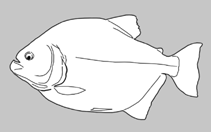
Classificazione / Nomi
Nomi Comuni | Sinonimi | Catalog of Fishes(Genere, Specie) | ITIS | CoL | WoRMS | Cloffa
>
Characiformes (Characins) >
Serrasalmidae (Piranhas and pacus) > Myleinae
Etymology: siderocarajensis: The specific name is in allusion to the locality `Serra and Carajás', the largest high-grade iron deposit in the world. Derived from the Greek‒Latin sidero means `iron', and carajensis in reference to the type locality. A toponymic adjective.
Ambiente: milieu / zona climatica / distribuzione batimetrica / gamma di distribuzione
Ecologia
; acqua dolce benthopelagico. Tropical
South America: ItacaiuÂnas River and Catete River, Tocantins-Araguaia River Basin, State of Para, Brazil.
Dimensione / Peso / Età
Maturità: Lm ? range ? - ? cm
Max length : 35.2 cm SL maschio/sesso non determinato; (Ref. 116762)
Breve descrizione
Chiavi di identificazione | Morfologia | Morfometria
Vertebre: 42. Tometes siderocarajensis can be diagnosed from all its congeners by dense pigmentation on the distalmost portion of the pelvic-fin rays or the entirety of the fin (vs. pelvic fin hyaline or pale, or with few scattered dark chromatophores along distal portion of rays). In addition, it differs from all congeners, except from T. camunani and T. kranponhah, by having more circumpeduncular scale rows 39?41 (vs. 38 or less), and from T. kranponhah and T. trilobatus by having 1st and 2nd labial premaxillary teeth laterally spaced (vs. 1st and 2nd labial premaxillary teeth with lateral contact). It is further distinguished from T. trilobatus by having more perforated lateral line scales 74±84 (vs. 58±72); from T. makue by having more spines on ventral keel 11±17 prepelvic spines and 26±33 total spines (vs. 0±9 and 10±23, respectively); and from T. lebaili by having a terminal to gently upturned mouth and invariably 5 dentary teeth (vs. a markedly upturned mouth and 6±7 dentary teeth) (Ref. 116762).
Body shape (shape guide): short and / or deep.
Inhabits rapids associated with rocky outcropping covered in aquatic macrophytes of the families Podostemaceae and Fabaceae, which serve as a food source for this fish. The stomach contents of one large specimen measuring 34.0 cm SL consisted mainly of large pieces of Podostemaceae (leaves and flowers), but also comprised of three small Fabaceae fruits and a cricket (Orthoptera). Occurs syntopically with three other serrasalmid, rapids-adapted species, namely, Mylesinus paucisquamatus, Myleus setiger, and Tometes ancylorhynchus. Commonly captured by local, professional and amateur fishermen in the Itacaiúnas River. One of the most in demand species for game fishing in the region based on fishermen report (Ref. 116762).
Ciclo vitale e comportamento di accoppiamento
Maturità | Riproduzione | Deposizione | Uova | Fecondità | Larve
Andrade, M.C., V.N. Machado, M. Jégu, I.P. Farias and T. Giarrizzo, 2017. A new species of Tometes Valenciennes 1850 (Characiformes: Serrasalmidae) from Tocantins-Araguaia River Basin based on integrative analysis of molecular and morphological data. Plos ONE 12(4):e0170053. (Ref. 116762)
Stato della Lista Rossa IUCN (Ref. 130435: Version 2025-2 (Global))
Minaccia per l'uomo
Harmless
Usi umani
Pesce da pesca sportiva: si
Strumenti
Rapporti speciali
Scarica XML
Fonti Internet
Stime basate su modelli
Indice di diversità filogenetica (Fonte Biblio.
82804): PD
50 = 0.5078 [Uniqueness, from 0.5 = low to 2.0 = high].
Bayesian length-weight: a=0.02399 (0.01109 - 0.05190), b=2.99 (2.80 - 3.18), in cm total length, based on LWR estimates for this (Sub)family-body shape (Ref.
93245).
Resilienza (Fonte Biblio.
120179): Alto, tempo minimo di raddoppiamento della popolazione meno di 15 mesi (Preliminary K or Fecundity.).
Vulnerabilità della pesca (Ref.
59153): Low to moderate vulnerability (33 of 100).
🛈