Ταξινόμηση / Ονόματα
Κοινά ονόματα | Συνώνυμα | Catalog of Fishes(Γένος, Είδη) | ITIS | CoL | WoRMS | Cloffa
>
Characiformes (Characins) >
Serrasalmidae (Piranhas and pacus) > Myleinae
Etymology: siderocarajensis: The specific name is in allusion to the locality `Serra and Carajás', the largest high-grade iron deposit in the world. Derived from the Greek‒Latin sidero means `iron', and carajensis in reference to the type locality. A toponymic adjective.
Περιβάλλον: περιβάλλον / κλιματική ζώνη / εύρος βάθους / εύρος διανομής
Οικολογία
; Γλυκού νερού βενθοπελαγικό. Tropical
South America: ItacaiuÂnas River and Catete River, Tocantins-Araguaia River Basin, State of Para, Brazil.
Μέγεθος / Βάρος / Ηλικία
Γεννητική Ωρίμανση: Lm ? range ? - ? cm
Max length : 35.2 cm SL αρσενικό/απροσδιόριστο; (Ref. 116762)
Σύντομη περιγραφή
Κλείδες προσδιορισμού | Μορφολογία | Μορφομετρία
Σπόνδυλοι: 42. Tometes siderocarajensis can be diagnosed from all its congeners by dense pigmentation on the distalmost portion of the pelvic-fin rays or the entirety of the fin (vs. pelvic fin hyaline or pale, or with few scattered dark chromatophores along distal portion of rays). In addition, it differs from all congeners, except from T. camunani and T. kranponhah, by having more circumpeduncular scale rows 39?41 (vs. 38 or less), and from T. kranponhah and T. trilobatus by having 1st and 2nd labial premaxillary teeth laterally spaced (vs. 1st and 2nd labial premaxillary teeth with lateral contact). It is further distinguished from T. trilobatus by having more perforated lateral line scales 74±84 (vs. 58±72); from T. makue by having more spines on ventral keel 11±17 prepelvic spines and 26±33 total spines (vs. 0±9 and 10±23, respectively); and from T. lebaili by having a terminal to gently upturned mouth and invariably 5 dentary teeth (vs. a markedly upturned mouth and 6±7 dentary teeth) (Ref. 116762).
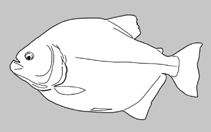
Body shape (shape guide): short and / or deep.
Inhabits rapids associated with rocky outcropping covered in aquatic macrophytes of the families Podostemaceae and Fabaceae, which serve as a food source for this fish. The stomach contents of one large specimen measuring 34.0 cm SL consisted mainly of large pieces of Podostemaceae (leaves and flowers), but also comprised of three small Fabaceae fruits and a cricket (Orthoptera). Occurs syntopically with three other serrasalmid, rapids-adapted species, namely, Mylesinus paucisquamatus, Myleus setiger, and Tometes ancylorhynchus. Commonly captured by local, professional and amateur fishermen in the Itacaiúnas River. One of the most in demand species for game fishing in the region based on fishermen report (Ref. 116762).
Κύκλος ζωής και συμπεριφορά ζευγαρώματος
Γεννητική Ωρίμανση | Αναπαραγωγή | Γεννοβολία | Αβγά | Γονιμότητα | Προνύμφες
Andrade, M.C., V.N. Machado, M. Jégu, I.P. Farias and T. Giarrizzo, 2017. A new species of Tometes Valenciennes 1850 (Characiformes: Serrasalmidae) from Tocantins-Araguaia River Basin based on integrative analysis of molecular and morphological data. Plos ONE 12(4):e0170053. (Ref. 116762)
Κατάσταση Κόκκινου Καταλόγου IUCN (Ref. 130435: Version 2025-2 (Global))
Απειλή για τον άνθρωπο
Harmless
Ανθρώπινες χρήσεις
αλιεία αναψυχής: ναί
Εργαλεία
Ειδικές εκθέσεις
Λήψη XML
Διαδικτυακές πηγές
Εκτιμήσεις βάσει μοντέλων
Δείκτης φυλογενετικής ποικιλότητας (Αναφ.
82804): PD
50 = 0.5078 [Uniqueness, from 0.5 = low to 2.0 = high].
Bayesian length-weight: a=0.02399 (0.01109 - 0.05190), b=2.99 (2.80 - 3.18), in cm total length, based on LWR estimates for this (Sub)family-body shape (Ref.
93245).
Ελαστικότητα (Αναφ.
120179): Υψηλό, ελάχιστος χρόνος για διπλασιασμό πληθυσμού < 15 μήνες (Preliminary K or Fecundity.).
Ευπάθεια στην αλιεία (Ref.
59153): Low to moderate vulnerability (33 of 100).
🛈