Classificação / Nomes
Nomes comuns | Sinónimos | Catalog of Fishes(Género, Espécies) | ITIS | CoL | WoRMS | Cloffa
>
Cypriniformes (Carps) >
Danionidae (Danios) > Chedrinae
Etymology: Engraulicypris: Greek, eggraulis, -eos = anchovy + Greek, kypris = the name of Aphrodite, proceeding from Kypris, (Cyprus), Greek, kyprinos = carp (Ref. 45335); gariepinus: The species name gariepinus refers to the Gariep, a San name for the Orange River that means 'great water' (Ref. 116496).
Ambiente: milieu / zona climática / intervalo de profundidade / gama de distribuição
Ecologia
; Água doce bentopelágico. Tropical
Africa: Orange River, below the Augrabies Falls, and its tributary the Gt. Fish River, in South Africa and Namibia (Ref. 93592, 116496).
Tamanho / Peso / Idade
Maturidade: Lm ? range ? - ? cm
Max length : 4.7 cm SL macho/indeterminado; (Ref. 116496)
Descrição breve
Chaves de identificação | Morfologia | Morfometria
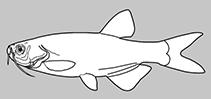
Espinhos dorsais (total) : 0; Raios dorsais moles (total) : 9 - 10; Espinhos anais: 0; Raios anais moles: 17 - 19; Vértebras: 36 - 38. Diagnosis: Caudal fin membrane clear to pale orange towards midline; anal fin extending over three quarters of length of caudal peduncle; caudal peduncle short; operculum entirely, not partially, shiny; body midline silver, not black; iris dark to light grey, not white; head with tubercles along lower jaw and lower head in breeding males; snout rounded, with dense dark spotting on tip; pelvic fin melanophores absent (Ref. 116496).
Body shape (shape guide): fusiform / normal.
This shoaling fish favours open, shallow water, normally occurring in slack pools and particularly below riffles; populations found in the lower Orange and Fish Rivers are limited by the Augrabies and Fish River Falls; they are restricted to turbid waters, which provide protection from visual predators (Ref. 116496). They are thought to feed mainly on small autochthonous invertebrates, e.g. planktonic crustaceans or insects, and are caught in large numbers where they occur (Ref. 116496).
Ciclo de vida e comportamento de acasalamento
Maturidade | Reprodução | Desova | Ovos | Fecundidade | Larvas
Riddin, M.A., I.R. Bills and M.H. Villet, 2016. Phylogeographic, morphometric and taxonomic re-evaluation of the river sardine, Mesobola brevianalis (Boulenger, 1908) (Teleostei, Cyprinidae, Chedrini). ZooKeys 641:121-150. (Ref. 116496)
Categoria na Lista Vermelha da IUCN (Ref. 130435: Version 2025-2 (Global))
Ameaça para o homem
Harmless
Utilização humana
Ferramentas
Relatórios especiais
Descarregue XML
Fontes da internet
Estimativas baseadas em modelos
Índice de diversidade filogenética (Ref.
82804): PD
50 = 0.5039 [Uniqueness, from 0.5 = low to 2.0 = high].
Bayesian length-weight: a=0.00589 (0.00280 - 0.01240), b=3.00 (2.82 - 3.18), in cm total length, based on LWR estimates for this (Sub)family-body shape (Ref.
93245).
Nível Trófico (Ref.
69278): 3.0 ±0.3 se; based on size and trophs of closest relatives
Resiliência (Ref.
120179): Elevada, tempo mínimo de duplicação da população menor que 15 meses (Preliminary K or Fecundity.).
Vulnerabilidade da pesca (Ref.
59153): Low vulnerability (10 of 100).
🛈