This website uses cookies to enhance your browsing experience and ensure the functionality of our site. For more detailed information about the types of cookies we use and how we protect your privacy, please visit our Privacy Information page.
×
Cookie Settings
This website uses different types of cookies to enhance your experience. Please select your preferences below:
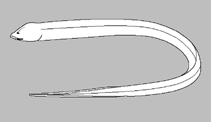
No image available for this species; drawing shows typical species in Synbranchidae.
分类 / 名称 俗名 | 同种异名 | Catalog of Fishes(属, 种) | ITIS | CoL | WoRMS | Cloffa
Teleostei > Synbranchiformes (Spiny eels) > Synbranchidae (Swamp-eels)
Etymology: luticolus:The species name is derived from the Latin word for mud, lutus, and the verb colere, to dwell, referring to the habitat in which the new species was collected; a noun in apposition (Ref. 116049).
Diagnosis: Monopterus luticolus is assigned to the 'Amphipnous group' within the genus Monopterus based on the presence of a unique synapomorphy of the group: the spatial dissociation of ceratobranchial 1 from hypobranchial 1 and its close association with hypobranchial 2 and ceratobranchial 2 (Ref. 116049). It is distinguished from all other species of synbranchids, including the other African synbranchids Ophisternon afrum and Monopterus boueti, by having more vertebrae, 198-208 vs. 100-194 (Ref. 116049). It is further distinguished from all synbranchids except O. infernale, O. candidum, M. boueti, M. eapeni, M. roseni, and M. digressus by the lack of externally visible eyes; Monopterus luticolus is also readily distinguished further from the African synbranchid species O. afrum by having the posttemporal greatly reduced in size and removed spatially from the supracleithrum and cleithrum, as well as from the skull, vs. posttemporal large, articulating with supracleithrum and epiotic of skull; and by having five vs. six branchiostegal rays (Ref. 116049). Monopterus luticolus is most similar to the West African M. boueti, from which it differs by having fewer abdominal vertebrae, 95-101 vs. 108, and more caudal vertebrae, 98-110 vs. 79-86; it differs further from M. boueti by several osteological characters (Ref. 116049).
Body shape (shape guide): eel-like.
Obligate air-breathing (Ref. 126274); This species was found during attempts to collect caecilian amphibians; they were dug from moist to wet soil, usually inundated by the neighbouring water body; the sites were immediately adjacent to both lotic and lentic aquatic habitats (Ref. 116049).
Britz, R., T.M. Doherty-Bone, M.T. Kouete, D. Sykes and D.J. Gower, 2016. Monopterus luticolus, a new species of swamp eel from Cameroon (Teleostei: Synbranchidae). Ichthyol. Explor. Freshwat. 27(4):309-323. (Ref. 116049)
世界自然保护联盟红皮书 (Ref. 130435: Version 2025-2 (Global))
系统发育多样性指数 (参考文献 82804): PD50 = 0.7500 [Uniqueness, from 0.5 = low to 2.0 = high].
Bayesian length-weight: a=0.00085 (0.00040 - 0.00182), b=3.09 (2.90 - 3.28), in cm total length, based on LWR estimates for this (Sub)family-body shape (Ref. 93245).
营养阶层 (参考文献 69278): 3.2 ±0.3 se; based on size and trophs of closest relatives
回复力 (参考文献 120179): 高度, 族群倍增时间少于 15个月 (Preliminary K or Fecundity.).
渔业脆弱性 (Ref. 59153): Low vulnerability (11 of 100). 🛈