Классификация / Имена
народные названия | синонимы | Catalog of Fishes(род, виды) | ITIS | CoL | WoRMS | Cloffa
>
Synbranchiformes (Spiny eels) >
Synbranchidae (Swamp-eels)
Etymology: luticolus: The species name is derived from the Latin word for mud, lutus, and the verb colere, to dwell, referring to the habitat in which the new species was collected; a noun in apposition (Ref. 116049).
Окружающая среда: среда / климатическая зона / пределы глубины / диапазон распространения
экология
; пресноводный демерсальный. Tropical
Africa: in the proximity of Mount Cameroon at altitudes of 35-170 m above sea level, Cameroon (Ref. 116049).
Размер / Вес / Возраст
половая зрелость: Lm ? range ? - ? cm
Max length : 20.9 cm TL самец/пол неопределен; (Ref. 118583)
Краткое описание
определительные ключи | морфология | морфометрия
Diagnosis: Monopterus luticolus is assigned to the 'Amphipnous group' within the genus Monopterus based on the presence of a unique synapomorphy of the group: the spatial dissociation of ceratobranchial 1 from hypobranchial 1 and its close association with hypobranchial 2 and ceratobranchial 2 (Ref. 116049). It is distinguished from all other species of synbranchids, including the other African synbranchids Ophisternon afrum and Monopterus boueti, by having more vertebrae, 198-208 vs. 100-194 (Ref. 116049). It is further distinguished from all synbranchids except O. infernale, O. candidum, M. boueti, M. eapeni, M. roseni, and M. digressus by the lack of externally visible eyes; Monopterus luticolus is also readily distinguished further from the African synbranchid species O. afrum by having the posttemporal greatly reduced in size and removed spatially from the supracleithrum and cleithrum, as well as from the skull, vs. posttemporal large, articulating with supracleithrum and epiotic of skull; and by having five vs. six branchiostegal rays (Ref. 116049). Monopterus luticolus is most similar to the West African M. boueti, from which it differs by having fewer abdominal vertebrae, 95-101 vs. 108, and more caudal vertebrae, 98-110 vs. 79-86; it differs further from M. boueti by several osteological characters (Ref. 116049).
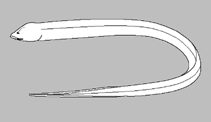
Body shape (shape guide): eel-like.
Obligate air-breathing (Ref. 126274); This species was found during attempts to collect caecilian amphibians; they were dug from moist to wet soil, usually inundated by the neighbouring water body; the sites were immediately adjacent to both lotic and lentic aquatic habitats (Ref. 116049).
Жизненный цикл и брачное поведение
половая зрелость | размножение | нерест | икра | Плодовитость | личинки
Britz, R., T.M. Doherty-Bone, M.T. Kouete, D. Sykes and D.J. Gower, 2016. Monopterus luticolus, a new species of swamp eel from Cameroon (Teleostei: Synbranchidae). Ichthyol. Explor. Freshwat. 27(4):309-323. (Ref. 116049)
Статус Красного Списка МСОП (Ref. 130435: Version 2025-2 (Global))
Угроза для людей
Harmless
Использование человеком
дополнительная информация
инструменты
Специальные отчеты
Скачать в формате XML
ресурсы в Интернет
Оценки, основанные на моделях
Индекс филогенетического разнообразия (ссылка
82804): PD
50 = 0.7500 [Uniqueness, from 0.5 = low to 2.0 = high].
Bayesian length-weight: a=0.00085 (0.00040 - 0.00182), b=3.09 (2.90 - 3.28), in cm total length, based on LWR estimates for this (Sub)family-body shape (Ref.
93245).
Трофический уровень (ссылка
69278): 3.2 ±0.3 se; based on size and trophs of closest relatives
устойчивость к внешним воздействиям (ссылка
120179): высокий, минимальное время удвоения популяции до 15 месяцев (Preliminary K or Fecundity.).
Уязвимость рыбной ловли (Ref.
59153): Low vulnerability (11 of 100).
🛈