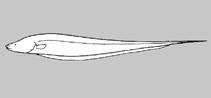
>
Gymnotiformes (Knifefishes) >
Sternopygidae (Glass knifefishes) > Eigenmanninae
Etymology: Eigenmannia: From Eigenmann, 1910, researcher of faunistic studies (Ref. 45335); desantanai: Named desantanai in honour of Carlos David de Santana, in recognition of his contributions to our knowledge of the Gymnotiformes (Ref. 115689).
Eponymy: Professor Dr Carl Henry Eigenmann (1863–1927) was a German-born American ichthyologist. [...] Dr Carlos David de Santana is a Brazilian ichthyologist who is presently a post-doctoral fellow at the Smithsonian. [...] (Ref. 128868), visit book page.
Môi trường: môi trường / vùng khí hậu / Mức độ sâu / phạm vi phân phối
Sinh thái học
; nước ngọt sống nổi và đáy. Tropical
South America: currently only known from Rio Cuiabá, Rio Paraguay basin, Mato Grosso, Brazil.
Bộ gần gũi / Khối lượng (Trọng lượng) / Tuổi
Chín muồi sinh dục: Lm ? range ? - ? cm
Max length : 18.6 cm TL con đực/không giới tính; (Ref. 115689)
Mô tả ngắn gọn
Khóa để định loại | Hình thái học | Sinh trắc học
Tia mềm vây hậu môn: 170 - 198. Diagnosis: Eigenmannia desantanai can be distinguished from other species in the E. trilineata species group by the inferior medial stripe, which is 1 scale deep (versus 2 or 3 scales deep); Eigenmannia desantanai can be further distinguished from the other members of the species group, except for E. waiwai, by the 11 or 12 precaudal vertebrae (versus 13 or 14 in E. antonioi; 15 in E. guairaca, E. muirapinima, and E. vicentespelaea; 13 in E. matintapereira; 14 or 15 in E. microstoma and E. trilineata; and 13–15 in E. pavulagem); Eigenmannia desantanai can be differentiated from E. waiwai by the terminal mouth (versus subterminal); the orbital diameter 14.5– 19.6% HL (versus 22.6–28.8%); the length of the anterodorsal process of the maxilla equal to 50% of the width of the posterior nostril (versus 1.5 times the width of the posterior nostril); the depth of the posterodorsal expansion on infraorbitals 1 + 2 approximately equal to the total length of infraorbitals 1 + 2 (versus less than 50% of the length of infraorbitals 1 + 2); and by the dentition pattern of the dentary with 21–23 teeth distributed in 2 rows (outermost row with 10 to 12 teeth; innermost row with 9 to 13 teeth) [versus 37 or 38 teeth distributed in 4 rows (outermost row with 7 teeth; 2nd with 11–15 teeth; 3rd with 8 to 15; innermost row with 4 to 8 teeth)] (Ref. 115689).
Body shape (shape guide): elongated.
Vòng đời và hành vi giao phối
Chín muồi sinh dục | Sự tái sinh sản | Đẻ trứng | Các trứng | Sự sinh sản | Ấu trùng
Peixoto, L.A.W., G.M. Dutra and W.B. Wosiacki, 2015. The electric glass knifefishes of the Eigenmannia trilineata species-group (Gymnotiformes: Sternopygidae): monophyly and description of seven new species. Zool. J. Linn. Soc. 175:384-414. (Ref. 115689)
Tình trạng Sách đỏ IUCN (Ref. 130435: Version 2025-2 (Global))
Mối đe dọa đối với con người
Harmless
Sử dụng của con người
Các nghề cá: không ích lợi (thú vị)
Các công cụ
Báo cáo đặc biệt
Tải xuống XML
Các nguồn internet
Ước tính dựa trên mô hình
Chỉ số đa dạng phát sinh loài (Tài liệu tham khảo
82804): PD
50 = 0.5000 [Uniqueness, from 0.5 = low to 2.0 = high].
Bayesian length-weight: a=0.00355 (0.00161 - 0.00782), b=2.97 (2.78 - 3.16), in cm total length, based on LWR estimates for this (Sub)family-body shape (Ref.
93245).
Mức dinh dưỡng (Tài liệu tham khảo
69278): 3.1 ±0.3 se; based on size and trophs of closest relatives
Sự dễ bị tổn thương của nghề đánh cá (Ref.
59153): Low vulnerability (10 of 100).
🛈