Classificação / Nomes
Nomes comuns | Sinónimos | Catalog of Fishes(Género, Espécies) | ITIS | CoL | WoRMS | Cloffa
>
Gymnotiformes (Knifefishes) >
Sternopygidae (Glass knifefishes) > Eigenmanninae
Etymology: Eigenmannia: From Eigenmann, 1910, researcher of faunistic studies (Ref. 45335); desantanai: Named desantanai in honour of Carlos David de Santana, in recognition of his contributions to our knowledge of the Gymnotiformes (Ref. 115689).
Eponymy: Professor Dr Carl Henry Eigenmann (1863–1927) was a German-born American ichthyologist. [...] Dr Carlos David de Santana is a Brazilian ichthyologist who is presently a post-doctoral fellow at the Smithsonian. [...] (Ref. 128868), visit book page.
Ambiente: milieu / zona climática / intervalo de profundidade / gama de distribuição
Ecologia
; Água doce bentopelágico. Tropical
South America: currently only known from Rio Cuiabá, Rio Paraguay basin, Mato Grosso, Brazil.
Tamanho / Peso / Idade
Maturidade: Lm ? range ? - ? cm
Max length : 18.6 cm TL macho/indeterminado; (Ref. 115689)
Descrição breve
Chaves de identificação | Morfologia | Morfometria
Raios anais moles: 170 - 198. Diagnosis: Eigenmannia desantanai can be distinguished from other species in the E. trilineata species group by the inferior medial stripe, which is 1 scale deep (versus 2 or 3 scales deep); Eigenmannia desantanai can be further distinguished from the other members of the species group, except for E. waiwai, by the 11 or 12 precaudal vertebrae (versus 13 or 14 in E. antonioi; 15 in E. guairaca, E. muirapinima, and E. vicentespelaea; 13 in E. matintapereira; 14 or 15 in E. microstoma and E. trilineata; and 13–15 in E. pavulagem); Eigenmannia desantanai can be differentiated from E. waiwai by the terminal mouth (versus subterminal); the orbital diameter 14.5– 19.6% HL (versus 22.6–28.8%); the length of the anterodorsal process of the maxilla equal to 50% of the width of the posterior nostril (versus 1.5 times the width of the posterior nostril); the depth of the posterodorsal expansion on infraorbitals 1 + 2 approximately equal to the total length of infraorbitals 1 + 2 (versus less than 50% of the length of infraorbitals 1 + 2); and by the dentition pattern of the dentary with 21–23 teeth distributed in 2 rows (outermost row with 10 to 12 teeth; innermost row with 9 to 13 teeth) [versus 37 or 38 teeth distributed in 4 rows (outermost row with 7 teeth; 2nd with 11–15 teeth; 3rd with 8 to 15; innermost row with 4 to 8 teeth)] (Ref. 115689).
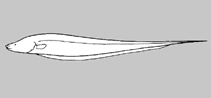
Body shape (shape guide): elongated.
Ciclo de vida e comportamento de acasalamento
Maturidade | Reprodução | Desova | Ovos | Fecundidade | Larvas
Peixoto, L.A.W., G.M. Dutra and W.B. Wosiacki, 2015. The electric glass knifefishes of the Eigenmannia trilineata species-group (Gymnotiformes: Sternopygidae): monophyly and description of seven new species. Zool. J. Linn. Soc. 175:384-414. (Ref. 115689)
Categoria na Lista Vermelha da IUCN (Ref. 130435: Version 2025-2 (Global))
Ameaça para o homem
Harmless
Utilização humana
Pescarias: sem interesse
Ferramentas
Relatórios especiais
Descarregue XML
Fontes da internet
Estimativas baseadas em modelos
Índice de diversidade filogenética (Ref.
82804): PD
50 = 0.5000 [Uniqueness, from 0.5 = low to 2.0 = high].
Bayesian length-weight: a=0.00355 (0.00161 - 0.00782), b=2.97 (2.78 - 3.16), in cm total length, based on LWR estimates for this (Sub)family-body shape (Ref.
93245).
Nível Trófico (Ref.
69278): 3.1 ±0.3 se; based on size and trophs of closest relatives
Vulnerabilidade da pesca (Ref.
59153): Low vulnerability (10 of 100).
🛈