Classification / Noms
Noms communs | Synonymes | Catalog of Fishes(Genre, Espèce) | ITIS | CoL | WoRMS | Cloffa
>
Characiformes (Characins) >
Serrasalmidae (Piranhas and pacus) > Myleinae
Etymology: Myloplus: Greek, mylos, -ou = grey mullet + Greek, plus, ploos = movement of a serpent; lucienae: Named for Luciene Maria Kassar Borges.
Eponymy: Dr Luciene Maria Kassar Borges is a zoologist and ichthyologist who has two bachelor’s degrees from the Federal University of Mato Grosso (1973 & 1976) and a master’s from the National Institute of Amazonian Research (1983). [...] (Ref. 128868), visit book page.
Environnement : milieu / zone climatique / profondeur / gamme de distribution
Écologie
; eau douce benthopélagique. Tropical; 1°N - 3°S, 68°W - 60°W (Ref. 114774)
South America: Brazil.
Taille / Poids / Âge
Maturité: Lm ? range ? - ? cm
Max length : 33.8 cm SL mâle / non sexé; (Ref. 114774)
Description synthétique
Clés d'identification | Morphologie | Morphométrie
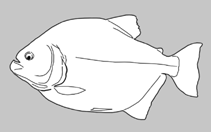
This species is distinguished from its congeners, except planquettei, zorroi, by having its anteriormost spine of prepelvic serra reaching only the middle of the abdomen between the verticals through pectoral and pelvic-fin origins (vs. reaching the vertical through pectoral-fin origin or almost so); differs from asterias, lobatus, planquettei, rhomboidalis, rubripinnis, ternetzi, zorroi by having fewer scale rows between lateral line and dorsal-fin origin 30-35 (vs. 36-61), and between lateral line and pelvic-fin origin 27-31 (vs. 32-63); from asterias, levis, tiete, torquatus, by having 18-22 branched dorsal-fin rays (vs. 24-27); from M. arnoldi by having a relatively elongate body, its body depth 53.0-64.5% of SL (vs. 69.0-76.9% of SL); from M. ternetzi by the presence of a pair of symphyseal teeth on dentary (vs. none); from M. schomburgkii by the absence of a vertical black stripe on middle portion of flank (vs. presence) (Ref. 114774).
Body shape (shape guide): short and / or deep; Cross section: compressed.
Usually found in rapids, but is also recorded for slow-flowing habitats such as backwaters and lakes (Ref. 114774).
Cycle de vie et comportement reproducteur
Maturité | Reproduction | Frai | Œufs | Fécondité | Larves
Andrade, M.C., R.O. Ota, D.A. Bastos and M. Jégu, 2016. A new large Myloplus Gill 1896 from rio Negro basin, Brazilian Amazon (Characiformes: Serrasalmidae). Zootaxa 4205(6):571-580. (Ref. 114774)
Statut dans la liste rouge de l'IUCN (Ref. 130435: Version 2025-2 (Global))
Menace pour l'homme
Harmless
Utilisations par l'homme
Outils
Articles particuliers
Télécharger en XML
Sources Internet
Estimations basées sur des modèles
Indice de diversité phylogénétique (Réf.
82804): PD
50 = 0.5001 [Uniqueness, from 0.5 = low to 2.0 = high].
Bayesian length-weight: a=0.02754 (0.01332 - 0.05696), b=2.96 (2.78 - 3.14), in cm total length, based on LWR estimates for this Genus-body shape (Ref.
93245).
Résilience (Réf.
120179): Haut, temps minimum de doublement de population inférieur à 15 mois (Preliminary K or Fecundity.).
Vulnérabilité de la pêche (Ref.
59153): Low to moderate vulnerability (31 of 100).
🛈