Ταξινόμηση / Ονόματα
Κοινά ονόματα | Συνώνυμα | Catalog of Fishes(Γένος, Είδη) | ITIS | CoL | WoRMS | Cloffa
>
Galaxiiformes (Southern smelts) >
Galaxiidae (Galaxiids) > Galaxiinae
Etymology: Galaxiella: Greek, galaxias, ou = a kind of fish, diminutive (Ref. 45335); toourtkoourt: The specific name is derived from the Australian indigenous language groups Tjapwurrung, Korn Kopan noot, and Peekwurrung, meaning 'little fish in freshwater'.
Περιβάλλον: περιβάλλον / κλιματική ζώνη / εύρος βάθους / εύρος διανομής
Οικολογία
; Γλυκού νερού; Υφάλμυρο βενθικό(ς); pH range: 5.3 - 9.3; μη μεταναστευτικό(ά). Tropical; 5°C - 27°C (Ref. 104902)
Oceania: southeastern mainland Australia from the upper Barwon River system near Barwon Downs, Victoria, west to the Cortina Lakes, near the Coorong, South Australia.
Μέγεθος / Βάρος / Ηλικία
Γεννητική Ωρίμανση: Lm ? range ? - ? cm
Max length : 3.4 cm TL αρσενικό/απροσδιόριστο; (Ref. 104902); 4.2 cm TL (female)
Σύντομη περιγραφή
Κλείδες προσδιορισμού | Μορφολογία | Μορφομετρία
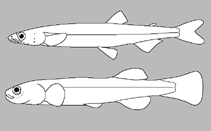
Μαλακές ραχιαίες ακτίνες (συνολικά) : 5 - 8; Μαλακές εδρικές ακτίνες: 7 - 10; Σπόνδυλοι: 34 - 38. Galaxiella toourtkoourt can be diagnosed from other congeners by following characters: caudal fin rays usually 13 (12-15); anal fin rays usually 8 (7-10); pectoral fin rays usually 12 (8-13); usually 36 (34-38) vertebrae; and 7 laterosensory pores in the preopercular-supramaxillary series. Adults very small (usually 2.06-3.06 cm SL in females; 1.67-2.40 cm SL in males); short caudal peduncle usually 19.6-21.9 % SL (17.2-23.8 % SL in females; 17.9-24.4 % SL in males); origin of dorsal fin more or less in line with anal fin (particularly females) with horizontal distance between dorsal fin and anal fin origins usually 0.0-2.7 % SL (2.5-2.8 in females; 2.6-3.9 in males). Adults possess three longitudinal black stripes (easier to discern in adult males) and reduced markings on ventral surface (typically two to three black blotches at isthmus) (Ref. 104902).
Body shape (shape guide): elongated.
Facultative air-breathing in the genus (Ref. 126274); Occurs in swamps, wetlands, shallow lakes, billabongs, small creeks and artificial earthen
drains at low elevation (mean 100 m above sea level, typically 22-176 m above sea level). Inhabits mostly shallow areas (mean maximum depth 1.1 m, typically 0.5-2.0 m), with still to low water velocities (or often backwaters in faster flowing conditions) and partial shading (mean 27 %, typically 5-50 % surface cover). Occasionally found in inland with slightly saline waters. Water quality measurements at the time of collection indicate this species can thrive in a broad range of conditions: water temperatures 5.2-26.9 °C; dissolved oxygen levels of 20-263 % saturation; pH of 5.3-9.3; water electrical conductivity of 94-13,620 μS/cm and turbidity of 1-96 NTU . Usually collected together with other native fish species, particularly Nannoperca australis (65 % frequency), Galaxias maculatus (12 % frequency), and burrowing crayfish (e.g. Engaeus spp., Geocharax spp.) (18 % frequency). Often found with introduced fish species Gambusia holbrooki (Ref. 104902).
Κύκλος ζωής και συμπεριφορά ζευγαρώματος
Γεννητική Ωρίμανση | Αναπαραγωγή | Γεννοβολία | Αβγά | Γονιμότητα | Προνύμφες
Coleman, R.A., A.A. Hoffmann and T.A. Raadik, 2015. A review of Galaxiella pusilla (Mack) (Teleostei: Galaxiidae) in south-eastern Australia with a description of a new species. Zootaxa 4021(2):243-281. (Ref. 104902)
Κατάσταση Κόκκινου Καταλόγου IUCN (Ref. 130435: Version 2025-2 (Global))
Απειλή για τον άνθρωπο
Harmless
Ανθρώπινες χρήσεις
Εργαλεία
Ειδικές εκθέσεις
Λήψη XML
Διαδικτυακές πηγές
Εκτιμήσεις βάσει μοντέλων
Δείκτης φυλογενετικής ποικιλότητας (Αναφ.
82804): PD
50 = 0.5625 [Uniqueness, from 0.5 = low to 2.0 = high].
Bayesian length-weight: a=0.00490 (0.00206 - 0.01165), b=3.12 (2.91 - 3.33), in cm total length, based on LWR estimates for this (Sub)family-body shape (Ref.
93245).
Τροφικό Επίπεδο (Αναφ.
69278): 3.1 ±0.3 se; based on size and trophs of closest relatives
Ελαστικότητα (Αναφ.
120179): Υψηλό, ελάχιστος χρόνος για διπλασιασμό πληθυσμού < 15 μήνες (Preliminary K or Fecundity.).
Ευπάθεια στην αλιεία (Ref.
59153): Low vulnerability (10 of 100).
🛈