分類 / 名稱
俗名 | 同種異名 | Catalog of Fishes(屬, 種) | ITIS | CoL | WoRMS | Cloffa
Teleostei >
Galaxiiformes (Southern smelts)
胡瓜魚目 (Southern smelts) >
Galaxiidae (Galaxiids)
南乳魚科 (Galaxiids) > Galaxiinae
Etymology: Galaxiella: Greek, galaxias, ou = a kind of fish, diminutive (Ref. 45335); toourtkoourt: The specific name is derived from the Australian indigenous language groups Tjapwurrung, Korn Kopan noot, and Peekwurrung, meaning 'little fish in freshwater'.
環境: 環境 / 氣候帶 / 深度上下限 / 配送範圍
生態學
; 淡水; 半鹹淡水 居於水底的; pH range: 5.3 - 9.3; 非遷移的. 5°C - 27°C (Ref. 104902)
分布
領土 | FAO區域 | 生態系 | 發現紀錄 | 分布圖 | 簡介 | Faunafri
Oceania: southeastern mainland Australia from the upper Barwon River system near Barwon Downs, Victoria, west to the Cortina Lakes, near the Coorong, South Australia.
大小 / 重量 / 年齡
成熟度: Lm ? range ? - ? cm
Max length : 3.4 cm TL 雄魚/尚未辨別雌雄; (Ref. 104902); 4.2 cm TL (female)
簡短描述
檢索表 | 型態特徵 | 形態測量圖
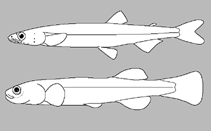
背的軟條 (總數) : 5 - 8; 臀鰭軟條: 7 - 10; 脊椎骨: 34 - 38. Galaxiella toourtkoourt can be diagnosed from other congeners by following characters: caudal fin rays usually 13 (12-15); anal fin rays usually 8 (7-10); pectoral fin rays usually 12 (8-13); usually 36 (34-38) vertebrae; and 7 laterosensory pores in the preopercular-supramaxillary series. Adults very small (usually 2.06-3.06 cm SL in females; 1.67-2.40 cm SL in males); short caudal peduncle usually 19.6-21.9 % SL (17.2-23.8 % SL in females; 17.9-24.4 % SL in males); origin of dorsal fin more or less in line with anal fin (particularly females) with horizontal distance between dorsal fin and anal fin origins usually 0.0-2.7 % SL (2.5-2.8 in females; 2.6-3.9 in males). Adults possess three longitudinal black stripes (easier to discern in adult males) and reduced markings on ventral surface (typically two to three black blotches at isthmus) (Ref. 104902).
Body shape (shape guide): elongated.
Facultative air-breathing in the genus (Ref. 126274); Occurs in swamps, wetlands, shallow lakes, billabongs, small creeks and artificial earthen
drains at low elevation (mean 100 m above sea level, typically 22-176 m above sea level). Inhabits mostly shallow areas (mean maximum depth 1.1 m, typically 0.5-2.0 m), with still to low water velocities (or often backwaters in faster flowing conditions) and partial shading (mean 27 %, typically 5-50 % surface cover). Occasionally found in inland with slightly saline waters. Water quality measurements at the time of collection indicate this species can thrive in a broad range of conditions: water temperatures 5.2-26.9 °C; dissolved oxygen levels of 20-263 % saturation; pH of 5.3-9.3; water electrical conductivity of 94-13,620 μS/cm and turbidity of 1-96 NTU . Usually collected together with other native fish species, particularly Nannoperca australis (65 % frequency), Galaxias maculatus (12 % frequency), and burrowing crayfish (e.g. Engaeus spp., Geocharax spp.) (18 % frequency). Often found with introduced fish species Gambusia holbrooki (Ref. 104902).
生命週期和交配行為
成熟度 | 繁殖 | 產卵場 | 卵 | 孕卵數 | 仔魚
Coleman, R.A., A.A. Hoffmann and T.A. Raadik, 2015. A review of Galaxiella pusilla (Mack) (Teleostei: Galaxiidae) in south-eastern Australia with a description of a new species. Zootaxa 4021(2):243-281. (Ref. 104902)
IUCN 瀕危狀態 (Ref. 130435: Version 2025-2 (Global))
易受傷害 (VU) (B2ab(i,iii)); Date assessed: 13 February 2019
人類使用
工具
特別的報告
下載 XML
網路資源
基於模型的估計
系統發育多樣性指數 (參考文獻
82804): PD
50 = 0.5625 [Uniqueness, from 0.5 = low to 2.0 = high].
Bayesian length-weight: a=0.00490 (0.00206 - 0.01165), b=3.12 (2.91 - 3.33), in cm total length, based on LWR estimates for this (Sub)family-body shape (Ref.
93245).
營養階層 (參考文獻
69278): 3.1 ±0.3 se; based on size and trophs of closest relatives
回復力 (參考文獻
120179): 高度, 族群倍增時間少於 15個月 (Preliminary K or Fecundity.).
釣魚的脆弱性 (Ref.
59153): Low vulnerability (10 of 100).
🛈