Classificação / Nomes
Nomes comuns | Sinónimos | Catalog of Fishes(Género, Espécies) | ITIS | CoL | WoRMS | Cloffa
>
Cypriniformes (Carps) >
Cyprinidae (Minnows or carps) > Smiliogastrinae
Etymology: Enteromius: Greek, enteron = intestine + Greek, myo, mys = muscle (Ref. 45335); vandewallei: This species is dedicated to Honorary Professor Pierre Vandewalle, University of Liège (Belgium), who introduced Djiman Lederoun to fish taxonomy (Ref. 114035).
Ambiente: milieu / zona climática / intervalo de profundidade / gama de distribuição
Ecologia
; Água doce bentopelágico. Tropical
Africa: Volta River basin in Benin, Burkina Faso and Ghana (Ref. 114035).
Tamanho / Peso / Idade
Maturidade: Lm ? range ? - ? cm
Max length : 4.8 cm SL macho/indeterminado; (Ref. 114035)
Descrição breve
Chaves de identificação | Morfologia | Morfometria
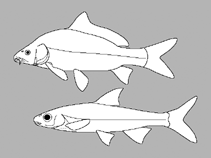
Espinhos dorsais (total) : 0; Raios dorsais moles (total) : 11; Espinhos anais: 0; Raios anais moles: 8; Vértebras: 32. Diagnosis: Enteromius vandewallei is distinguished from all other Enteromius species of West Africa by the following unique combination of characters: last simple dorsal-fin ray smooth on posterior margin, vs. denticulate in E. cadenati, E. carcharhinoides, E. dialonensis and E. guineensis; 4.5 scales between dorsal-fin base and lateral line, vs. 5.5 in E. subinensis and 3.5 in E. ablabes, E. aboinensis, E. aliciae, E. anema, E. baudoni, E. bawkuensis, E. callipterus, E. clauseni, E. eburneensis, E. guildi, E. huguenyi, E. liberiensis, E. macrops, E. melanotaenia, E. niokoloensis, E. parablabes, E. pumilus, punctitaeniatus, E. raimbaulti, E. teugelsi, E. trispiloides, E. walkeri and E. zalbiensis; two pairs of barbels, vs. no barbels in E. leonensis, E. salessei, E. stigmatopygus and E. sylvaticus, and only one pair in E. pobeguini; no spots on the flanks, vs. spots present in E. anniae, E. boboi, E. camptacanthus, E. lauzannei, E. macinensis, E. perince, E. sublineatus, E. tiekoroi, E. traorei and E. trispilos; 12 scale rows around caudal peduncle, vs. 9-10 in E. inaequalis and 10 in E. ditinensis; a black band in the middle of the flanks, vs. no band in E. bagbwensis and E. foutensis; long barbels, the anterior pair reaching the posterior half of eye, the posterior one reaching the front edge of the pre-opercula, vs. short barbels, the anterior pair falling short of eye, the posterior sometimes extending beyond center of eye in E. atakorensis; 8 branched dorsal-fin rays, vs. 7 in E. atakorensis; lateral line clearly depressed below the dorsal fin, vs. lateral line straight in E. chlorotaenia and E. bigornei; head length 26.4-28.4% of standard length, vs. 22.6-25.7% in E. nigeriensis; interorbital width 22-27% of head length, vs. 27-36% in E. nigeriensis; and with a rather narrow, black, longitudinal band covering less than 0.5 scale in the middle of the flanks and rising about 1 scale above lateral line at the level of the dorsal fin, vs. longitudinal band, whenever present, often wider, covering more than 0.5 scale in the middle of the flanks while rising only about 0.5 a scale above the lateral line in E. nigeriensis (Ref. 114035).
Body shape (shape guide): fusiform / normal.
Ciclo de vida e comportamento de acasalamento
Maturidade | Reprodução | Desova | Ovos | Fecundidade | Larvas
Lederoun, D. and E. Vreven, 2016. Enteromius vandewallei, a new species of minnow from the Volta River basin, West Africa (Cypriniformes: Cyprinidae). Ichthyol. Explor. Freshwat. 27(2):97-106. (Ref. 114035)
Categoria na Lista Vermelha da IUCN (Ref. 130435: Version 2025-2 (Global))
Ameaça para o homem
Harmless
Utilização humana
Pescarias: sem interesse
Ferramentas
Relatórios especiais
Descarregue XML
Fontes da internet
Estimativas baseadas em modelos
Índice de diversidade filogenética (Ref.
82804): PD
50 = 0.5000 [Uniqueness, from 0.5 = low to 2.0 = high].
Bayesian length-weight: a=0.00603 (0.00282 - 0.01286), b=3.06 (2.87 - 3.25), in cm total length, based on LWR estimates for this (Sub)family-body shape (Ref.
93245).
Nível Trófico (Ref.
69278): 3.0 ±0.3 se; based on size and trophs of closest relatives
Resiliência (Ref.
120179): Elevada, tempo mínimo de duplicação da população menor que 15 meses (Preliminary K or Fecundity.).
Vulnerabilidade da pesca (Ref.
59153): Low vulnerability (10 of 100).
🛈