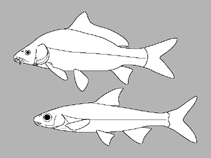
Klassifizierung / Names
Namen | Synonyme | Catalog of Fishes(Gattung, Arten) | ITIS | CoL | WoRMS | Cloffa
>
Cypriniformes (Carps) >
Cyprinidae (Minnows or carps) > Smiliogastrinae
Etymology: Enteromius: Greek, enteron = intestine + Greek, myo, mys = muscle (Ref. 45335); vandewallei: This species is dedicated to Honorary Professor Pierre Vandewalle, University of Liège (Belgium), who introduced Djiman Lederoun to fish taxonomy (Ref. 114035).
Umwelt: Milieu / Klimazone / Tiefenbereich / Verbreitungsgebiet
Ökologie
; süßwasser benthopelagisch. Tropical
Africa: Volta River basin in Benin, Burkina Faso and Ghana (Ref. 114035).
Größe / Gewicht / Alter
Geschlechtsreife: Lm ? range ? - ? cm
Max length : 4.8 cm SL Männchen/unbestimmt; (Ref. 114035)
Kurzbeschreibung
Bestimmungsschlüssel | Morphologie | Morphometrie
Rückenflossenstacheln (insgesamt) : 0; Rückenflossenweichstrahlen (insgesamt) : 11; Afterflossenstacheln: 0; Afterflossenweichstrahlen: 8; Wirbelzahl: 32. Diagnosis: Enteromius vandewallei is distinguished from all other Enteromius species of West Africa by the following unique combination of characters: last simple dorsal-fin ray smooth on posterior margin, vs. denticulate in E. cadenati, E. carcharhinoides, E. dialonensis and E. guineensis; 4.5 scales between dorsal-fin base and lateral line, vs. 5.5 in E. subinensis and 3.5 in E. ablabes, E. aboinensis, E. aliciae, E. anema, E. baudoni, E. bawkuensis, E. callipterus, E. clauseni, E. eburneensis, E. guildi, E. huguenyi, E. liberiensis, E. macrops, E. melanotaenia, E. niokoloensis, E. parablabes, E. pumilus, punctitaeniatus, E. raimbaulti, E. teugelsi, E. trispiloides, E. walkeri and E. zalbiensis; two pairs of barbels, vs. no barbels in E. leonensis, E. salessei, E. stigmatopygus and E. sylvaticus, and only one pair in E. pobeguini; no spots on the flanks, vs. spots present in E. anniae, E. boboi, E. camptacanthus, E. lauzannei, E. macinensis, E. perince, E. sublineatus, E. tiekoroi, E. traorei and E. trispilos; 12 scale rows around caudal peduncle, vs. 9-10 in E. inaequalis and 10 in E. ditinensis; a black band in the middle of the flanks, vs. no band in E. bagbwensis and E. foutensis; long barbels, the anterior pair reaching the posterior half of eye, the posterior one reaching the front edge of the pre-opercula, vs. short barbels, the anterior pair falling short of eye, the posterior sometimes extending beyond center of eye in E. atakorensis; 8 branched dorsal-fin rays, vs. 7 in E. atakorensis; lateral line clearly depressed below the dorsal fin, vs. lateral line straight in E. chlorotaenia and E. bigornei; head length 26.4-28.4% of standard length, vs. 22.6-25.7% in E. nigeriensis; interorbital width 22-27% of head length, vs. 27-36% in E. nigeriensis; and with a rather narrow, black, longitudinal band covering less than 0.5 scale in the middle of the flanks and rising about 1 scale above lateral line at the level of the dorsal fin, vs. longitudinal band, whenever present, often wider, covering more than 0.5 scale in the middle of the flanks while rising only about 0.5 a scale above the lateral line in E. nigeriensis (Ref. 114035).
Body shape (shape guide): fusiform / normal.
Lebenszyklus und Paarungsverhalten
Geschlechtsreife | Fortpflanzung | Ablaichen | Eier | Fruchtbarkeit | Larven
Lederoun, D. and E. Vreven, 2016. Enteromius vandewallei, a new species of minnow from the Volta River basin, West Africa (Cypriniformes: Cyprinidae). Ichthyol. Explor. Freshwat. 27(2):97-106. (Ref. 114035)
IUCN Rote Liste Status (Ref. 130435: Version 2025-2 (Global))
Bedrohung für Menschen
Harmless
Nutzung durch Menschen
Fischereien: nicht kommerziell
Tools
Zusatzinformationen
Download XML
Internet Quellen
Schätzungen auf der Grundlage von Modellen
Phylogenetischer Diversitätsindex (Ref.
82804): PD
50 = 0.5000 [Uniqueness, from 0.5 = low to 2.0 = high].
Bayesian length-weight: a=0.00603 (0.00282 - 0.01286), b=3.06 (2.87 - 3.25), in cm total length, based on LWR estimates for this (Sub)family-body shape (Ref.
93245).
Trophische Ebene (Ref.
69278): 3.0 ±0.3 se; based on size and trophs of closest relatives
Widerstandsfähigkeit (Ref.
120179): hoch, Verdopplung der Population dauert weniger als 15 Monate. (Preliminary K or Fecundity.).
Anfälligkeit der Fischerei (Ref.
59153): Low vulnerability (10 of 100).
🛈