Classificação / Nomes
Nomes comuns | Sinônimos | Catalog of Fishes(Gênero, Espécies) | ITIS | CoL | WoRMS | Cloffa
>
Cyprinodontiformes (Rivulines, killifishes and live bearers) >
Procatopodidae (African lampeyes) > Procatopodinae
Etymology: Hypsopanchax: Greek, hypsi = high + Panchax, a word created by Meinken in 1932; stiassnyae: The species is named after Melanie L.J. Stiassny of the American Museum of Natural History, New York, who supported the authors in many ways during their studies on the systematics of the Cyprinodontiformes of the Congo basin (Ref. 103403).
Eponymy: Dr Melanie Lisa Jane Stiassny (d: 1953) is a British-born naturalized American citizen who is Herbert R. [...] (Ref. 128868), visit book page.
Meio ambiente: milieu / Zona climática / intervalo de profundidade / faixa de distribuição
Ecologia
; Água doce bentopelágico; pH range: 6.2 - 6.2. Tropical; 29°C - ? (Ref. 103403)
Africa: only known from the Kambambe River (Lulua River tributary, Kasai drainage, middle Congo River basin), in Democratic Republic of the Congo (Ref. 103403).
Tamanho / Peso / Idade
Maturidade: Lm ? range ? - ? cm
Max length : 3.0 cm SL macho/indeterminado; (Ref. 103403)
Descrição suscinta
Chaves de identificação | Morfologia | Morfometria
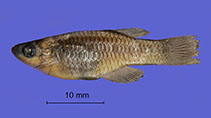
Espinhos dorsais (total) : 0; Raios dorsais (total) : 9 - 10; Espinhos anais: 0; Raios anais : 15 - 16. Diagnosis: Hypsopanchax stiassnyae is distinguished from deep-bodied Hylopanchax species by its diverging supra-orbital cephalic sensory system versus parallel in Hylopanchax; it is distinguished from deep-bodied Plataplochilus species by its open supra-orbital cephalic sensory system versus a tubular system with large pores; it is distinguished from Procatopus and the northern Hypsopanchax, H. catenatus, H. platysternus and H. zebra, and Platypanchax modestus by the supra-orbital cephalic sensory system lacking a zigzag structure (Ref. 103403). Hypsopanchax differs from Hylopanchax and Plataplochilus by the lack of branchiostegal appendages in males (Ref. 103403). Hypsopanchax stiassnyae differs from H. jubbi by the shorter snout, 3.3-3.7% of standard length vs. 4.5-5.7%, the shorter anterior part of the supra-orbital cephalic sensory system, 36.5% of length of supra-orbital sensory system vs. 53.2, the absence of well developed lobes bordering the grooves of the supra-orbital sensory system, and a lower number of circumpeduncular scales, 10 vs. 11-12; it is distinguished from H. jobaerti by a straight dorsal profile vs. a convex profile, with relatively longer neural spines 6-11 in H. jobaerti, a shorter dorsal and anal fin base in females, dorsal fin base 11.8-12.1% of standard length vs. 13.2-13.8, anal fin base 15.2-16.3% of standard length vs. 16.8-19.0, and in males unpaired fins completely dark grey vs. only the distal edge of unpaired fins with dark pigmentation; in addition, they can be distinguished by a less deep body, especially in females, males 27.9-32.5% of standard length vs. 31.5-39.3, females 27.7-29.1% of standard length vs. 30.0-32.9, and slightly lower number of anal-fin rays, males 15-16 vs. 16-18, females 15 vs. 16-18 (Ref. 103403).
Body shape (shape guide): fusiform / normal.
Currently only found in Kambambe River, a 2-5 meter wide, fast flowing tributary of Lulua River, bottom with sand and pebbles, bordered by gallery forest; the water is brownish with total dissolved ion concentration of 3 ppm and pH 6.2 (Ref. 103403).
Ciclo de vida ou comportamento de acasalamento
Maturidade | Reprodução | Desova | Ovos | Fecundidade | Larvas
van der Zee, J.R., R. Sonnenberg and J.J. Mbimbi Mayi Munene, 2015. Hypsopanchax stiassnyae, a new poeciliid fish from the Lulua River (Democratic Republic of Congo) (Teleostei: Cyprinodontiformes). Ichthyol. Explor. Freshwat. 26(1):87-96. (Ref. 103403)
Status na Lista Vermelha da UICN (Ref. 130435: Version 2025-2 (Global))
Ameaça para os humanos
Harmless
Uso pelos humanos
Ferramentas
Relatórios especiais
Baixar XML
Fontes da internet
Estimativas baseadas em modelos
Índice de diversidade filogenética (Ref.
82804): PD
50 = 0.5156 [Uniqueness, from 0.5 = low to 2.0 = high].
Bayesian length-weight: a=0.00562 (0.00224 - 0.01412), b=3.07 (2.85 - 3.29), in cm total length, based on LWR estimates for this (Sub)family-body shape (Ref.
93245).
Nível Trófico (Ref.
69278): 3.1 ±0.4 se; based on size and trophs of closest relatives
Vulnerabilidade da pesca (Ref.
59153): Low vulnerability (10 of 100).
🛈