klasifikasi / Nama
Nama-nama umum | Sinonim (persamaan) | Catalog of Fishes(Marga, Jenis) | ITIS | CoL | WoRMS | Cloffa
>
Cyprinodontiformes (Rivulines, killifishes and live bearers) >
Procatopodidae (African lampeyes) > Procatopodinae
Etymology: Hypsopanchax: Greek, hypsi = high + Panchax, a word created by Meinken in 1932; stiassnyae: The species is named after Melanie L.J. Stiassny of the American Museum of Natural History, New York, who supported the authors in many ways during their studies on the systematics of the Cyprinodontiformes of the Congo basin (Ref. 103403).
Eponymy: Dr Melanie Lisa Jane Stiassny (d: 1953) is a British-born naturalized American citizen who is Herbert R. [...] (Ref. 128868), visit book page.
Lingkungan: lingkungan / zona iklim / kisaran kedalaman / jangkauan distribusi
Ekologi
; air tawar bentopelagis; pH range: 6.2 - 6.2. Tropical; 29°C - ? (Ref. 103403)
Africa: only known from the Kambambe River (Lulua River tributary, Kasai drainage, middle Congo River basin), in Democratic Republic of the Congo (Ref. 103403).
Ukuran / Berat / umur
Kematangan: Lm ? range ? - ? cm
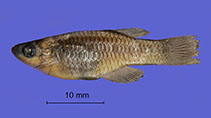
Max length : 3.0 cm SL jantan/; (Ref. 103403)
deskripsi pendek
Kunci identifiaksi (pengenalan) | Morfologi | Morfometrik
Duri punggung (Keseluruhan (total)) : 0; duri punggung lunak (Keseluruhan (total)) : 9 - 10; Duri dubur: 0; Sirip dubur lunak: 15 - 16. Diagnosis: Hypsopanchax stiassnyae is distinguished from deep-bodied Hylopanchax species by its diverging supra-orbital cephalic sensory system versus parallel in Hylopanchax; it is distinguished from deep-bodied Plataplochilus species by its open supra-orbital cephalic sensory system versus a tubular system with large pores; it is distinguished from Procatopus and the northern Hypsopanchax, H. catenatus, H. platysternus and H. zebra, and Platypanchax modestus by the supra-orbital cephalic sensory system lacking a zigzag structure (Ref. 103403). Hypsopanchax differs from Hylopanchax and Plataplochilus by the lack of branchiostegal appendages in males (Ref. 103403). Hypsopanchax stiassnyae differs from H. jubbi by the shorter snout, 3.3-3.7% of standard length vs. 4.5-5.7%, the shorter anterior part of the supra-orbital cephalic sensory system, 36.5% of length of supra-orbital sensory system vs. 53.2, the absence of well developed lobes bordering the grooves of the supra-orbital sensory system, and a lower number of circumpeduncular scales, 10 vs. 11-12; it is distinguished from H. jobaerti by a straight dorsal profile vs. a convex profile, with relatively longer neural spines 6-11 in H. jobaerti, a shorter dorsal and anal fin base in females, dorsal fin base 11.8-12.1% of standard length vs. 13.2-13.8, anal fin base 15.2-16.3% of standard length vs. 16.8-19.0, and in males unpaired fins completely dark grey vs. only the distal edge of unpaired fins with dark pigmentation; in addition, they can be distinguished by a less deep body, especially in females, males 27.9-32.5% of standard length vs. 31.5-39.3, females 27.7-29.1% of standard length vs. 30.0-32.9, and slightly lower number of anal-fin rays, males 15-16 vs. 16-18, females 15 vs. 16-18 (Ref. 103403).
Body shape (shape guide): fusiform / normal.
Currently only found in Kambambe River, a 2-5 meter wide, fast flowing tributary of Lulua River, bottom with sand and pebbles, bordered by gallery forest; the water is brownish with total dissolved ion concentration of 3 ppm and pH 6.2 (Ref. 103403).
Siklus hidup dan perilaku kawin
Kematangan | Reproduksi, perkembang biakan | Pemijahan | telur-telur | Fekunditas | Larva
van der Zee, J.R., R. Sonnenberg and J.J. Mbimbi Mayi Munene, 2015. Hypsopanchax stiassnyae, a new poeciliid fish from the Lulua River (Democratic Republic of Congo) (Teleostei: Cyprinodontiformes). Ichthyol. Explor. Freshwat. 26(1):87-96. (Ref. 103403)
Status IUCN Red List (Ref. 130435: Version 2025-2 (Global))
ancaman kepada manusia
Harmless
penggunaan manusia
Alat, peralatan
laporan khas
muat turun XML
Sumber internet
Estimasi berdasarkan model
Indeks keanekaragaman filogenetik (Acuan
82804): PD
50 = 0.5156 [Uniqueness, from 0.5 = low to 2.0 = high].
Bayesian length-weight: a=0.00562 (0.00224 - 0.01412), b=3.07 (2.85 - 3.29), in cm total length, based on LWR estimates for this (Sub)family-body shape (Ref.
93245).
Tingkat Trofik (Acuan
69278): 3.1 ±0.4 se; based on size and trophs of closest relatives
Kerentanan Penangkapan Ikan (Ref.
59153): Low vulnerability (10 of 100).
🛈