Classificazione / Nomi
Nomi Comuni | Sinonimi | Catalog of Fishes(Genere, Specie) | ITIS | CoL | WoRMS | Cloffa
>
Siluriformes (Catfishes) >
Amphiliidae (Loach catfishes) > Amphiliinae
Etymology: Amphilius: Greek, amphi = on both sides + Greek, leios = fat; ruziziensis: Named for the Ruzizi River drainage in eastern Rwanda and Burundi, where type specimens of this species were collected and the species is primarily distributed (Ref. 103388).
Ambiente: milieu / zona climatica / distribuzione batimetrica / gamma di distribuzione
Ecologia
; acqua dolce demersale. Tropical
Africa: Ruzizi River drainage (Ref. 103388) and northeastern tributaries of Lake Tanganyika in Burundi (Ref. 103388).
Dimensione / Peso / Età
Maturità: Lm ? range ? - ? cm
Max length : 12.1 cm SL maschio/sesso non determinato; (Ref. 103388)
Breve descrizione
Chiavi di identificazione | Morfologia | Morfometria
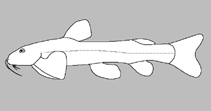
Spine dorsali (totale) : 0; Raggi dorsali molli (totale) : 7; Spine anali: 0; Raggi anali molli: 7 - 10. Diagnosis: Amphilius ruziziensis is diagnosed from A. pedunculus, A. frieli, and A. crassus by its more slender caudal peduncle, caudal peduncle depth 8.6-9.5% of standard length vs. 9.7-12.3%, and from A. jacksonii, A. pedunculus, A. crassus, and A. lujani by its narrower interorbital width, 23.4-25.1% of head length vs. 26.7-35.8% (Ref. 103388). It is further diagnosed from A. frieli, A. crassus, and A. lujani by its more slender body, body depth at anus 11.1-12.9% of standard length vs. 13.5-17.4% (Ref. 103388). Amphilius ruziziensis is further diagnosed from A. frieli by having fewer branchiostegal rays, 6-7 vs. 8-9, fewer total gill rakers on the first gill arch, 6-8, rarely 5 or 9 vs. 10-11, rarely 9 or 12, and a longer caudal peduncle, caydal peduncle length 18.7-20.3% of standard length vs. 14.4-16.4%; it is further diagnosed from A. crassus by a longer caudal peduncle, caudal peduncle length 18.7-20.3% of standard length vs. 13.3-15.5%, and shorter dorsal-fin insertion to adipose-fin insertion length, 38.2-41.5% of standard length vs. 42.2-44.6%; it is further diagnosed from A. jacksonii by its deeper caudal peduncle, caudal peduncle depth 8.6-9.5% of standard length vs. 4.8-7.9% (Ref. 103388).
Body shape (shape guide): elongated.
Ciclo vitale e comportamento di accoppiamento
Maturità | Riproduzione | Deposizione | Uova | Fecondità | Larve
Thomson, A.W., L.M. Page and S.A. Hilber, 2015. Revision of the Amphilius jacksonii complex (Siluriformes: Amphiliidae), with the descriptions of five new species. Zootaxa 3986(1):61-87. (Ref. 103388)
Stato della Lista Rossa IUCN (Ref. 130435: Version 2025-2 (Global))
Minaccia per l'uomo
Harmless
Usi umani
Strumenti
Rapporti speciali
Scarica XML
Fonti Internet
Stime basate su modelli
Indice di diversità filogenetica (Fonte Biblio.
82804): PD
50 = 0.5000 [Uniqueness, from 0.5 = low to 2.0 = high].
Bayesian length-weight: a=0.00490 (0.00203 - 0.01181), b=3.15 (2.94 - 3.36), in cm total length, based on LWR estimates for this (Sub)family-body shape (Ref.
93245).
Livello trofico (Fonte Biblio.
69278): 3.0 ±0.3 se; based on size and trophs of closest relatives
Resilienza (Fonte Biblio.
120179): Medio, tempo minimo di raddoppiamento della popolazione 1.4 - 4.4 anni (Preliminary K or Fecundity.).
Vulnerabilità della pesca (Ref.
59153): Low vulnerability (10 of 100).
🛈