Classification / Noms
Noms communs | Synonymes | Catalog of Fishes(Genre, Espèce) | ITIS | CoL | WoRMS | Cloffa
>
Siluriformes (Catfishes) >
Amphiliidae (Loach catfishes) > Amphiliinae
Etymology: Amphilius: Greek, amphi = on both sides + Greek, leios = fat; ruziziensis: Named for the Ruzizi River drainage in eastern Rwanda and Burundi, where type specimens of this species were collected and the species is primarily distributed (Ref. 103388).
Environnement : milieu / zone climatique / profondeur / gamme de distribution
Écologie
; eau douce démersal. Tropical
Africa: Ruzizi River drainage (Ref. 103388) and northeastern tributaries of Lake Tanganyika in Burundi (Ref. 103388).
Taille / Poids / Âge
Maturité: Lm ? range ? - ? cm
Max length : 12.1 cm SL mâle / non sexé; (Ref. 103388)
Description synthétique
Clés d'identification | Morphologie | Morphométrie
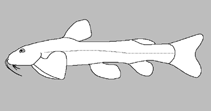
Épines dorsales (Total) : 0; Rayons mous dorsaux (Total) : 7; Épines anales: 0; Rayons mous anaux: 7 - 10. Diagnosis: Amphilius ruziziensis is diagnosed from A. pedunculus, A. frieli, and A. crassus by its more slender caudal peduncle, caudal peduncle depth 8.6-9.5% of standard length vs. 9.7-12.3%, and from A. jacksonii, A. pedunculus, A. crassus, and A. lujani by its narrower interorbital width, 23.4-25.1% of head length vs. 26.7-35.8% (Ref. 103388). It is further diagnosed from A. frieli, A. crassus, and A. lujani by its more slender body, body depth at anus 11.1-12.9% of standard length vs. 13.5-17.4% (Ref. 103388). Amphilius ruziziensis is further diagnosed from A. frieli by having fewer branchiostegal rays, 6-7 vs. 8-9, fewer total gill rakers on the first gill arch, 6-8, rarely 5 or 9 vs. 10-11, rarely 9 or 12, and a longer caudal peduncle, caydal peduncle length 18.7-20.3% of standard length vs. 14.4-16.4%; it is further diagnosed from A. crassus by a longer caudal peduncle, caudal peduncle length 18.7-20.3% of standard length vs. 13.3-15.5%, and shorter dorsal-fin insertion to adipose-fin insertion length, 38.2-41.5% of standard length vs. 42.2-44.6%; it is further diagnosed from A. jacksonii by its deeper caudal peduncle, caudal peduncle depth 8.6-9.5% of standard length vs. 4.8-7.9% (Ref. 103388).
Body shape (shape guide): elongated.
Cycle de vie et comportement reproducteur
Maturité | Reproduction | Frai | Œufs | Fécondité | Larves
Thomson, A.W., L.M. Page and S.A. Hilber, 2015. Revision of the Amphilius jacksonii complex (Siluriformes: Amphiliidae), with the descriptions of five new species. Zootaxa 3986(1):61-87. (Ref. 103388)
Statut dans la liste rouge de l'IUCN (Ref. 130435: Version 2025-2 (Global))
Menace pour l'homme
Harmless
Utilisations par l'homme
Outils
Articles particuliers
Télécharger en XML
Sources Internet
Estimations basées sur des modèles
Indice de diversité phylogénétique (Réf.
82804): PD
50 = 0.5000 [Uniqueness, from 0.5 = low to 2.0 = high].
Bayesian length-weight: a=0.00490 (0.00203 - 0.01181), b=3.15 (2.94 - 3.36), in cm total length, based on LWR estimates for this (Sub)family-body shape (Ref.
93245).
Niveau trophique (Réf.
69278): 3.0 ±0.3 se; based on size and trophs of closest relatives
Résilience (Réf.
120179): Milieu, temps minimum de doublement de population : 1,4 à 4,4 années (Preliminary K or Fecundity.).
Vulnérabilité de la pêche (Ref.
59153): Low vulnerability (10 of 100).
🛈