>
Cyprinodontiformes (Rivulines, killifishes and live bearers) >
Rivulidae (Rivulines) > Cynolebiinae
Etymology: cricarensis: The specific name cricarensis is a reference to the occurrence of the new species in the Cricaré river basin, the former native name for the present day São Mateus River.
Môi trường: môi trường / vùng khí hậu / Mức độ sâu / phạm vi phân phối
Sinh thái học
; nước ngọt sống nổi và đáy. Tropical
South America: São Mateus river basin in Brazil.
Bộ gần gũi / Khối lượng (Trọng lượng) / Tuổi
Chín muồi sinh dục: Lm ? range ? - ? cm
Max length : 3.5 cm SL con đực/không giới tính; (Ref. 96072); 2.8 cm SL (female)
Mô tả ngắn gọn
Khóa để định loại | Hình thái học | Sinh trắc học
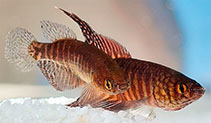
Các vây lưng mềm (tổng cộng) : 14 - 18; Tia mềm vây hậu môn: 20 - 23; Động vật có xương sống: 28. Xenurolebias cricarensis can be diagnosed from X. myersi and X. pataxo by having dark reddish brown bars on the caudal fin slightly contrasting with lighter interspaces in males (vs. strongly contrasting); from X. izecksohni in having a deeper head in males (head depth 85.6-92.8% of head length vs. 81.2-85.0%), a longer lower jaw in males (22.0-25.0% of head length vs. 18.6-20.9%), a deeper body in larger males (above 31 mm SL) (body depth 30.7-33.9% SL, vs. 27.1-27.5% SL), and dorsal and anal-fin filaments reaching between the base and middle of the caudal fin in males (vs. reaching posterior portion of the caudal fin). It can be further distinguished from X. myersi by having the caudal fin lanceolate in larger males, with a pronounced posterior tip (vs. sub-lanceolate, never forming a distinctive tip posteriorly) and more dark brown bars on the caudal fin in males (7-10 vs. 4-6); and from X. pataxo by having 1-5 black spots on the posterior part of the caudal peduncle in females (vs. absence) (Ref. 96072).
Body shape (shape guide): fusiform / normal.
Occurs in a temporary swamp. A portion of the swamp is located in the border of a small forest fragment, and a part extending to an area without trees but densely occupied by the cattail Typha domingensis (Ref. 96072).
Vòng đời và hành vi giao phối
Chín muồi sinh dục | Sự tái sinh sản | Đẻ trứng | Các trứng | Sự sinh sản | Ấu trùng
Costa, W.J.E.M. and P.F. Amorim, 2014. Integrative taxonomy and conservation of seasonal killifishes, Xenurolebias (Teleostei: Rivulidae), and the Brazilian Atlantic forest. Systematic and Biodiversity (Ref. 96072)
Tình trạng Sách đỏ IUCN (Ref. 130435: Version 2025-2 (Global))
Mối đe dọa đối với con người
Harmless
Sử dụng của con người
Các công cụ
Báo cáo đặc biệt
Tải xuống XML
Các nguồn internet
Ước tính dựa trên mô hình
Chỉ số đa dạng phát sinh loài (Tài liệu tham khảo
82804): PD
50 = 0.5312 [Uniqueness, from 0.5 = low to 2.0 = high].
Bayesian length-weight: a=0.01122 (0.00514 - 0.02450), b=3.04 (2.87 - 3.21), in cm total length, based on all LWR estimates for this body shape (Ref.
93245).
Mức dinh dưỡng (Tài liệu tham khảo
69278): 3.1 ±0.4 se; based on size and trophs of closest relatives
Thích nghi nhanh (Tài liệu tham khảo
120179): Chiêù cao, thời gian nhân đôi của chủng quần tối thiểu là dưới 15 tháng (Preliminary K or Fecundity.).
Sự dễ bị tổn thương của nghề đánh cá (Ref.
59153): Low vulnerability (10 of 100).
🛈