Clasificación / Nombres
Nombres comunes | Sinónimos | Catalog of Fishes(Género, Especie) | ITIS | CoL | WoRMS | Cloffa
>
Cyprinodontiformes (Rivulines, killifishes and live bearers) >
Rivulidae (Rivulines) > Cynolebiinae
Etymology: cricarensis: The specific name cricarensis is a reference to the occurrence of the new species in the Cricaré river basin, the former native name for the present day São Mateus River.
Entorno: milieu / zona climática / rango de profundidad / gama de distribución
Ecología
; agua dulce bentopelágico. Tropical
South America: São Mateus river basin in Brazil.
Tamaño / Peso / Edad
Madurez: Lm ? range ? - ? cm
Max length : 3.5 cm SL macho / no sexado; (Ref. 96072); 2.8 cm SL (female)
Descripción breve
Claves de identificación | Morfología | Morfometría
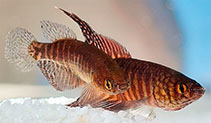
Radios blandos dorsales (total) : 14 - 18; Radios blandos anales: 20 - 23; Vértebra: 28. Xenurolebias cricarensis can be diagnosed from X. myersi and X. pataxo by having dark reddish brown bars on the caudal fin slightly contrasting with lighter interspaces in males (vs. strongly contrasting); from X. izecksohni in having a deeper head in males (head depth 85.6-92.8% of head length vs. 81.2-85.0%), a longer lower jaw in males (22.0-25.0% of head length vs. 18.6-20.9%), a deeper body in larger males (above 31 mm SL) (body depth 30.7-33.9% SL, vs. 27.1-27.5% SL), and dorsal and anal-fin filaments reaching between the base and middle of the caudal fin in males (vs. reaching posterior portion of the caudal fin). It can be further distinguished from X. myersi by having the caudal fin lanceolate in larger males, with a pronounced posterior tip (vs. sub-lanceolate, never forming a distinctive tip posteriorly) and more dark brown bars on the caudal fin in males (7-10 vs. 4-6); and from X. pataxo by having 1-5 black spots on the posterior part of the caudal peduncle in females (vs. absence) (Ref. 96072).
Body shape (shape guide): fusiform / normal.
Occurs in a temporary swamp. A portion of the swamp is located in the border of a small forest fragment, and a part extending to an area without trees but densely occupied by the cattail Typha domingensis (Ref. 96072).
Ciclo vital y comportamiento de apareamiento
Madurez | Reproducción | Puesta | Huevos | Fecundidad | Larva
Costa, W.J.E.M. and P.F. Amorim, 2014. Integrative taxonomy and conservation of seasonal killifishes, Xenurolebias (Teleostei: Rivulidae), and the Brazilian Atlantic forest. Systematic and Biodiversity (Ref. 96072)
Situación en la Lista Roja de la UICN (Ref. 130435: Version 2025-2 (Global))
Amenaza para el ser humano
Harmless
Usos humanos
Herramientas
Informes especiales
Descargar XML
Fuentes de Internet
Estimaciones basadas en modelos
Índice de diversidad filogenética (Referencia
82804): PD
50 = 0.5312 [Uniqueness, from 0.5 = low to 2.0 = high].
Bayesian length-weight: a=0.01122 (0.00514 - 0.02450), b=3.04 (2.87 - 3.21), in cm total length, based on all LWR estimates for this body shape (Ref.
93245).
Nivel trófico (Referencia
69278): 3.1 ±0.4 se; based on size and trophs of closest relatives
Resiliencia (Referencia
120179): Alto, población duplicada en un tiempo mínimo inferior a 15 meses (Preliminary K or Fecundity.).
Vulnerabilidad pesquera (Ref.
59153): Low vulnerability (10 of 100).
🛈