>
Cypriniformes (Carps) >
Danionidae (Danios) > Chedrinae
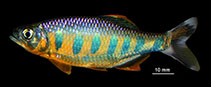
Etymology: ardens: From the Latin adjective ardens, meaning burning, an allusion to the flame-like colors in mature males.
Entorno: milieu / zona climática / rango de profundidad / gama de distribución
Ecología
; agua dulce bentopelágico. Tropical
Asia: Sita-Swarna River system in the Western Ghats of Karnataka, India.
Tamaño / Peso / Edad
Madurez: Lm ? range ? - ? cm
Max length : 8.7 cm SL macho / no sexado; (Ref. 100448)
Descripción breve
Claves de identificación | Morfología | Morfometría
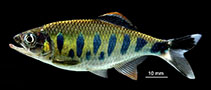
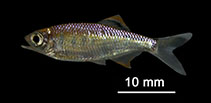
Radios blandos dorsales (total) : 13; Radios blandos anales: 16. Barilius ardens can be distinguished from B. canarensis and B. malabaricus by having a color pattern consisting of a row of 7-9 large, vertically-elongate, bluish-green blotches 4-6 scales high and 2-3 scales wide along the length of the body, of which in large adults the first three blotches are fragmented into a smaller row of blotches (vs. single or double rows of spots along the length of the body, the first row with 9-13 round or oval bluish-green spots 1-2 scales high and 1-2 scales wide and the second row, if present, with 3-4 smaller spots reaching up to the anal-fin origin). It differs from both B. canarensis and B. malabaricus by having 5+4+3 (vs. 5+4+2) teeth on the fifth ceratobranchial. It further differs from B. canarensis by having 16-18 (vs.14-15) predorsal scales, and having the dorsal and anal fins margined with bright orange (vs. broadly margined with white). In addition, it can be separated from B. malabaricus by having 10½ (vs. 11½) branched dorsal-fin rays and 13½ (vs. 14½-15½) branched anal-fin rays. It can be disinguished from B. bakeri by its unique color pattern, consisting of a row of 7-9 large, vertically-elongate bluish-green blotches 4-6 scales high and 2-3 scales wide along the length of the body, of which in large adults the first three blotches are broken up into a smaller row of intercalate blotches (vs. only a single row of spots along the length of the body); its fifth ceratobranchial with 5+4+3 (vs. 5+4+2) teeth; and the dorsal and anal fins margined with bright orange (vs. white) (Ref. 100448).
Body shape (shape guide): fusiform / normal.
Ciclo vital y comportamiento de apareamiento
Madurez | Reproducción | Puesta | Huevos | Fecundidad | Larva
Knight, J.D.M., A. Rai, R.K.P. D'Souza and B. Vijaykrishnan, 2015. Barilius ardens (Teleostei: Cyprinidae), a new species from the Western Ghats, India, with redescription of B. malabaricus and B. canarensis. Zootaxa 3926(3):396-412. (Ref. 100448)
Situación en la Lista Roja de la UICN (Ref. 130435: Version 2025-2 (Global))
Amenaza para el ser humano
Harmless
Usos humanos
Herramientas
Informes especiales
Descargar XML
Fuentes de Internet
Estimaciones basadas en modelos
Índice de diversidad filogenética (Referencia
82804): PD
50 = 0.5000 [Uniqueness, from 0.5 = low to 2.0 = high].
Bayesian length-weight: a=0.00724 (0.00327 - 0.01603), b=3.04 (2.86 - 3.22), in cm total length, based on LWR estimates for this (Sub)family-body shape (Ref.
93245).
Nivel trófico (Referencia
69278): 3.3 ±0.4 se; based on size and trophs of closest relatives
Resiliencia (Referencia
120179): Alto, población duplicada en un tiempo mínimo inferior a 15 meses (Preliminary K or Fecundity.).
Vulnerabilidad pesquera (Ref.
59153): Low vulnerability (10 of 100).
🛈