Classification / Noms
Noms communs | Synonymes | Catalog of Fishes(Genre, Espèce) | ITIS | CoL | WoRMS | Cloffa
>
Cypriniformes (Carps) >
Danionidae (Danios) > Chedrinae
Etymology: ardens: From the Latin adjective ardens, meaning burning, an allusion to the flame-like colors in mature males.
Environnement : milieu / zone climatique / profondeur / gamme de distribution
Écologie
; eau douce benthopélagique. Tropical
Asia: Sita-Swarna River system in the Western Ghats of Karnataka, India.
Taille / Poids / Âge
Maturité: Lm ? range ? - ? cm
Max length : 8.7 cm SL mâle / non sexé; (Ref. 100448)
Description synthétique
Clés d'identification | Morphologie | Morphométrie
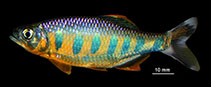
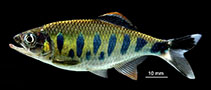
Rayons mous dorsaux (Total) : 13; Rayons mous anaux: 16. Barilius ardens can be distinguished from B. canarensis and B. malabaricus by having a color pattern consisting of a row of 7-9 large, vertically-elongate, bluish-green blotches 4-6 scales high and 2-3 scales wide along the length of the body, of which in large adults the first three blotches are fragmented into a smaller row of blotches (vs. single or double rows of spots along the length of the body, the first row with 9-13 round or oval bluish-green spots 1-2 scales high and 1-2 scales wide and the second row, if present, with 3-4 smaller spots reaching up to the anal-fin origin). It differs from both B. canarensis and B. malabaricus by having 5+4+3 (vs. 5+4+2) teeth on the fifth ceratobranchial. It further differs from B. canarensis by having 16-18 (vs.14-15) predorsal scales, and having the dorsal and anal fins margined with bright orange (vs. broadly margined with white). In addition, it can be separated from B. malabaricus by having 10½ (vs. 11½) branched dorsal-fin rays and 13½ (vs. 14½-15½) branched anal-fin rays. It can be disinguished from B. bakeri by its unique color pattern, consisting of a row of 7-9 large, vertically-elongate bluish-green blotches 4-6 scales high and 2-3 scales wide along the length of the body, of which in large adults the first three blotches are broken up into a smaller row of intercalate blotches (vs. only a single row of spots along the length of the body); its fifth ceratobranchial with 5+4+3 (vs. 5+4+2) teeth; and the dorsal and anal fins margined with bright orange (vs. white) (Ref. 100448).
Body shape (shape guide): fusiform / normal.
Cycle de vie et comportement reproducteur
Maturité | Reproduction | Frai | Œufs | Fécondité | Larves
Knight, J.D.M., A. Rai, R.K.P. D'Souza and B. Vijaykrishnan, 2015. Barilius ardens (Teleostei: Cyprinidae), a new species from the Western Ghats, India, with redescription of B. malabaricus and B. canarensis. Zootaxa 3926(3):396-412. (Ref. 100448)
Statut dans la liste rouge de l'IUCN (Ref. 130435: Version 2025-2 (Global))
Menace pour l'homme
Harmless
Utilisations par l'homme
Outils
Articles particuliers
Télécharger en XML
Sources Internet
Estimations basées sur des modèles
Indice de diversité phylogénétique (Réf.
82804): PD
50 = 0.5000 [Uniqueness, from 0.5 = low to 2.0 = high].
Bayesian length-weight: a=0.00724 (0.00327 - 0.01603), b=3.04 (2.86 - 3.22), in cm total length, based on LWR estimates for this (Sub)family-body shape (Ref.
93245).
Niveau trophique (Réf.
69278): 3.3 ±0.4 se; based on size and trophs of closest relatives
Résilience (Réf.
120179): Haut, temps minimum de doublement de population inférieur à 15 mois (Preliminary K or Fecundity.).
Vulnérabilité de la pêche (Ref.
59153): Low vulnerability (10 of 100).
🛈