>
Gobiiformes (Gobies) >
Gobiidae (Gobies) > Gobiinae
Etymology: Gobius: Latin, gobius = gudgeon (Ref. 45335); incognitus: Name from Latin 'incognitus' meaning unknown; referring to the long period of time that passed until this common and widespread species was recognized and described.
Ambiente: milieu / zona climática / intervalo de profundidade / gama de distribuição
Ecologia
marinhas bentopelágico; intervalo de profundidade 0 - 12 m (Ref. 110727). Temperate
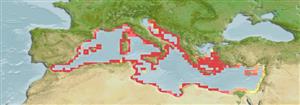
Mediterranean (Aegean Sea, Adriatic Sea, Gulf of Lion, Ionian Sea and the Spanish W Mediterranean) and NE Atlantic; absent from the Sea of Marmara and the Black Sea.
Tamanho / Peso / Idade
Maturidade: Lm ? range ? - ? cm
Max length : 9.5 cm SL macho/indeterminado; (Ref. 110727)
Descrição breve
Chaves de identificação | Morfologia | Morfometria
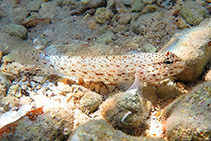
Espinhos dorsais (total) : 7; Raios dorsais moles (total) : 13 - 14; Espinhos anais: 1; Raios anais moles: 12 - 13. This species is distinguished from its congeners by the following characters: scales in lateral series 51-59; predorsal scales 25-35; in adults, opercle with 10-16 scales; pectoral-fin rays 18-20; free tips on upper pectoral rays well developed and the first ray longer than two thirds of the entire ray length; pelvic fin disc is complete, its anterior membrane without lateral lobes; anterior oculoscapular canal with pore 'alpha' at rear of orbit; oculoscapular row x1 is not extending forwards to pore ß; suborbital row d is discontinuous with large gap below suborbital rows 3 and 4; eye diameter 1.08-1.32 in snout length; the pigment dots on the cheek are irregularly scattered or, if rows are visible, then additional dots or a third row are present across the middle of the cheek between the lower row starting anteriorly at the angle of mouth and the upper row that touches ventral margin of eye; upper mark on the P base single or doubled, reaching downwards to 8th-10th rays counting from the upper part of fin (Ref. 110727).
G. incognitus differs from G. bucchichi by the following morphological characters: dots on the cheek irregularly scattered or, if rows are visible, then additional dots or a third row present across the middle of the cheek between the lower row starting anteriorly at the angle of mouth and the upper row that touches ventral margin of eye vs. 2 rows two rows of elongated dots on cheek without dots between them at the middle of the cheek, the lower row starting anteriorly at the angle of mouth and going posteriorly across cheek and opercle to pectoral-fin base, and the upper row starting at upper lips, going posterodorsally to touch ventral margin of eye and continuing behind eye; upper mark on the P base single or doubled, reaching downwards to 8th-10th rays counting from the upper end vs. upper mark on the P base single or doubled, reaching downwards to 6th to 7th rays counting from upper end; pectoral-fin rays 18-20 (rarely 18) vs. 17-18; free tips on upper pectoral rays well developed and the first ray longer than two thirds of the entire ray length vs. free tips on three upper pectoral rays moderately developed and the first ray shorter than half of the entire ray length; in adults, opercle with 10-16 scales vs. naked, rarely 2-4 scales may be visible; predorsal scales 25-35 (rarely 25) vs. 20-25 (rarely 25); suborbital row d is discontinuous with large gap below suborbital rows 3 and 4 vs. suborbital row d continuous; eye diameter 1.08-1.32 in snout length vs. eyes larger and snout shorter with eye diameter 0?82–1?04 in snout length) (Ref. 110727).
Body shape (shape guide): elongated; Cross section: compressed.
Collected from just below the water surface (north Adriatic Sea) down to 12 m in depth (Israel). The depth range in Israel (4-12 m) was deeper compared with other areas (Adriatic 0-5 m, France 1.5-6 m, Crete 2-9 m). It occurs on all kinds of substrata: sand, gravel, cobbles, boulders and bedrock, but mostly on different combinations of mixed substratum which can be bare or
covered to varying degrees by short thallus algae, Caulerpa prolifera and Cystoseira
spp., or sea grasses Posidonia oceanica and Cymodocea nodosa (Ref. 110727).
Ciclo de vida e comportamento de acasalamento
Maturidade | Reprodução | Desova | Ovos | Fecundidade | Larvas
Kovačić, M., J.P. Renoult, R. Pillon, M. Bilecenoglu, F. Tiralongo, S.V. Bogorodsky, S. Engin, O. Kovtun, P. Louisy, R.A. Patzner, S.B.-S. Rothman, A. Soldo and M.B. Yokes, 2023. The delimitation of geographic distributions of Gobius bucchichi and Gobius incognitus (Teleostei: Gobiidae). J. Mar. Sci. Engg 11(art. 516):1-12. (Ref. 129796)
Categoria na Lista Vermelha da IUCN (Ref. 130435: Version 2025-2 (Global))
Ameaça para o homem
Harmless
Utilização humana
Ferramentas
Relatórios especiais
Descarregue XML
Fontes da internet
Estimativas baseadas em modelos
Índice de diversidade filogenética (Ref.
82804): PD
50 = 0.5000 [Uniqueness, from 0.5 = low to 2.0 = high].
Bayesian length-weight: a=0.00813 (0.00508 - 0.01300), b=3.08 (2.95 - 3.21), in cm total length, based on LWR estimates for this species & Genus-body shape (Ref.
93245).
Nível Trófico (Ref.
69278): 3.2 ±0.2 se; based on size and trophs of closest relatives
Resiliência (Ref.
120179): Elevada, tempo mínimo de duplicação da população menor que 15 meses (Preliminary K or Fecundity.).
Vulnerabilidade da pesca (Ref.
59153): Low vulnerability (10 of 100).
🛈