>
Gobiiformes (Gobies) >
Gobiidae (Gobies) > Gobiinae
Etymology: Gobius: Latin, gobius = gudgeon (Ref. 45335); incognitus: Name from Latin 'incognitus' meaning unknown; referring to the long period of time that passed until this common and widespread species was recognized and described.
Περιβάλλον: περιβάλλον / κλιματική ζώνη / εύρος βάθους / εύρος διανομής
Οικολογία
Θαλασσινό(ά) βενθοπελαγικό; εύρος βάθους 0 - 12 m (Ref. 110727). Temperate
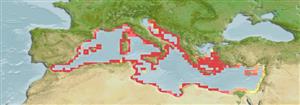
Mediterranean (Aegean Sea, Adriatic Sea, Gulf of Lion, Ionian Sea and the Spanish W Mediterranean) and NE Atlantic; absent from the Sea of Marmara and the Black Sea.
Μέγεθος / Βάρος / Ηλικία
Γεννητική Ωρίμανση: Lm ? range ? - ? cm
Max length : 9.5 cm SL αρσενικό/απροσδιόριστο; (Ref. 110727)
Σύντομη περιγραφή
Κλείδες προσδιορισμού | Μορφολογία | Μορφομετρία
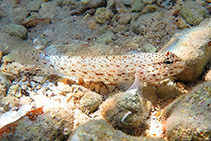
Ραχιαίες άκανθες (συνολικά) : 7; Μαλακές ραχιαίες ακτίνες (συνολικά) : 13 - 14; Εδρικές άκανθες: 1; Μαλακές εδρικές ακτίνες: 12 - 13. This species is distinguished from its congeners by the following characters: scales in lateral series 51-59; predorsal scales 25-35; in adults, opercle with 10-16 scales; pectoral-fin rays 18-20; free tips on upper pectoral rays well developed and the first ray longer than two thirds of the entire ray length; pelvic fin disc is complete, its anterior membrane without lateral lobes; anterior oculoscapular canal with pore 'alpha' at rear of orbit; oculoscapular row x1 is not extending forwards to pore ß; suborbital row d is discontinuous with large gap below suborbital rows 3 and 4; eye diameter 1.08-1.32 in snout length; the pigment dots on the cheek are irregularly scattered or, if rows are visible, then additional dots or a third row are present across the middle of the cheek between the lower row starting anteriorly at the angle of mouth and the upper row that touches ventral margin of eye; upper mark on the P base single or doubled, reaching downwards to 8th-10th rays counting from the upper part of fin (Ref. 110727).
G. incognitus differs from G. bucchichi by the following morphological characters: dots on the cheek irregularly scattered or, if rows are visible, then additional dots or a third row present across the middle of the cheek between the lower row starting anteriorly at the angle of mouth and the upper row that touches ventral margin of eye vs. 2 rows two rows of elongated dots on cheek without dots between them at the middle of the cheek, the lower row starting anteriorly at the angle of mouth and going posteriorly across cheek and opercle to pectoral-fin base, and the upper row starting at upper lips, going posterodorsally to touch ventral margin of eye and continuing behind eye; upper mark on the P base single or doubled, reaching downwards to 8th-10th rays counting from the upper end vs. upper mark on the P base single or doubled, reaching downwards to 6th to 7th rays counting from upper end; pectoral-fin rays 18-20 (rarely 18) vs. 17-18; free tips on upper pectoral rays well developed and the first ray longer than two thirds of the entire ray length vs. free tips on three upper pectoral rays moderately developed and the first ray shorter than half of the entire ray length; in adults, opercle with 10-16 scales vs. naked, rarely 2-4 scales may be visible; predorsal scales 25-35 (rarely 25) vs. 20-25 (rarely 25); suborbital row d is discontinuous with large gap below suborbital rows 3 and 4 vs. suborbital row d continuous; eye diameter 1.08-1.32 in snout length vs. eyes larger and snout shorter with eye diameter 0?82–1?04 in snout length) (Ref. 110727).
Body shape (shape guide): elongated; Cross section: compressed.
Collected from just below the water surface (north Adriatic Sea) down to 12 m in depth (Israel). The depth range in Israel (4-12 m) was deeper compared with other areas (Adriatic 0-5 m, France 1.5-6 m, Crete 2-9 m). It occurs on all kinds of substrata: sand, gravel, cobbles, boulders and bedrock, but mostly on different combinations of mixed substratum which can be bare or
covered to varying degrees by short thallus algae, Caulerpa prolifera and Cystoseira
spp., or sea grasses Posidonia oceanica and Cymodocea nodosa (Ref. 110727).
Κύκλος ζωής και συμπεριφορά ζευγαρώματος
Γεννητική Ωρίμανση | Αναπαραγωγή | Γεννοβολία | Αβγά | Γονιμότητα | Προνύμφες
Kovačić, M., J.P. Renoult, R. Pillon, M. Bilecenoglu, F. Tiralongo, S.V. Bogorodsky, S. Engin, O. Kovtun, P. Louisy, R.A. Patzner, S.B.-S. Rothman, A. Soldo and M.B. Yokes, 2023. The delimitation of geographic distributions of Gobius bucchichi and Gobius incognitus (Teleostei: Gobiidae). J. Mar. Sci. Engg 11(art. 516):1-12. (Ref. 129796)
Κατάσταση Κόκκινου Καταλόγου IUCN (Ref. 130435: Version 2025-2 (Global))
Απειλή για τον άνθρωπο
Harmless
Ανθρώπινες χρήσεις
Εργαλεία
Ειδικές εκθέσεις
Λήψη XML
Διαδικτυακές πηγές
Εκτιμήσεις βάσει μοντέλων
Δείκτης φυλογενετικής ποικιλότητας (Αναφ.
82804): PD
50 = 0.5000 [Uniqueness, from 0.5 = low to 2.0 = high].
Bayesian length-weight: a=0.00813 (0.00508 - 0.01300), b=3.08 (2.95 - 3.21), in cm total length, based on LWR estimates for this species & Genus-body shape (Ref.
93245).
Τροφικό Επίπεδο (Αναφ.
69278): 3.2 ±0.2 se; based on size and trophs of closest relatives
Ελαστικότητα (Αναφ.
120179): Υψηλό, ελάχιστος χρόνος για διπλασιασμό πληθυσμού < 15 μήνες (Preliminary K or Fecundity.).
Ευπάθεια στην αλιεία (Ref.
59153): Low vulnerability (10 of 100).
🛈