Klassifizierung / Names
Namen | Synonyme | Catalog of Fishes(Gattung, Arten) | ITIS | CoL | WoRMS | Cloffa
>
Gobiiformes (Gobies) >
Gobiidae (Gobies) > Gobiinae
Etymology: Lubricogobius: Latin, lubricus = slipperiness, smoothness + Latin, gobius = gudgeon (Ref. 45335); nanus: Name from Latin 'nanus' , referring to its small size, which is the most diminutive in the genus.
Umwelt: Milieu / Klimazone / Tiefenbereich / Verbreitungsgebiet
Ökologie
seewasser benthopelagisch; tiefenbereich 8 - 13 m (Ref. 107278). Tropical
Western Pacific: Papua New Guinea.
Größe / Gewicht / Alter
Geschlechtsreife: Lm ? range ? - ? cm
Max length : 1.1 cm SL Männchen/unbestimmt; (Ref. 107278); 1.1 cm SL (female)
Kurzbeschreibung
Bestimmungsschlüssel | Morphologie | Morphometrie
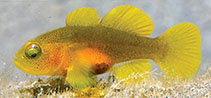
Rückenflossenstacheln (insgesamt) : 7; Rückenflossenweichstrahlen (insgesamt) : 10 - 11; Afterflossenstacheln: 1; Afterflossenweichstrahlen: 8 - 9. This species is distinguished by the following characters: D VI-I,10-11; A I,8-9; pectoral-fin rays 19; with anterior nostrils; no scales; pelvic disc with distinct frenum; mid-lateral row of widely-spaced sensory papillae on side of body and approximately 15 scattered sensory papillae on middle portion of caudal fin; body depth 3.0-3.4 in SL; head length 2.7-2.9 in SL; head compressed, width 1.1-1.4 in head depth; rounded caudal fin, shorter than head, in SL; colour in life generally brown except the yellowish head and fins with dense covering of tiny brown chromatophores, those of pectoral and pelvic fins are mainly confined to basal half of fin; iris yellow (Ref. 107278).
Body shape (shape guide): fusiform / normal; Cross section: compressed.
The type specimens were obtained within 100 m of each other on an approximately 20° mud slope. Two specimens were collected together from the inside of a dead bivalve while the other two were found on either filamentous algae or sponge that covered bottom debris, including a piece of wood and a cement block, and a fifth uncollected specimen was also observed and photographed in the same dead bivalve mentioned above (Ref. 107278).
Lebenszyklus und Paarungsverhalten
Geschlechtsreife | Fortpflanzung | Ablaichen | Eier | Fruchtbarkeit | Larven
Allen, G.R., 2015. Lubricogobius nanus, a new species of goby (Pisces: Gobiidae) from eastern Papua New Guinea. J. Ocean Sci. Found. 17:1-11. (Ref. 107278)
IUCN Rote Liste Status (Ref. 130435: Version 2025-2 (Global))
Bedrohung für Menschen
Harmless
Nutzung durch Menschen
Fischereien: nicht kommerziell
Tools
Zusatzinformationen
Download XML
Internet Quellen
Schätzungen auf der Grundlage von Modellen
Phylogenetischer Diversitätsindex (Ref.
82804): PD
50 = 0.5078 [Uniqueness, from 0.5 = low to 2.0 = high].
Bayesian length-weight: a=0.01023 (0.00477 - 0.02194), b=3.01 (2.83 - 3.19), in cm total length, based on LWR estimates for this (Sub)family-body shape (Ref.
93245).
Trophische Ebene (Ref.
69278): 2.9 ±0.3 se; based on size and trophs of closest relatives
Widerstandsfähigkeit (Ref.
120179): hoch, Verdopplung der Population dauert weniger als 15 Monate. (Preliminary K or Fecundity.).
Anfälligkeit der Fischerei (Ref.
59153): Low vulnerability (10 of 100).
🛈