>
Gobiiformes (Gobies) >
Gobiidae (Gobies) > Gobiinae
Etymology: Lubricogobius: Latin, lubricus = slipperiness, smoothness + Latin, gobius = gudgeon (Ref. 45335); nanus: Name from Latin 'nanus' , referring to its small size, which is the most diminutive in the genus.
Environnement : milieu / zone climatique / profondeur / gamme de distribution
Écologie
marin benthopélagique; profondeur 8 - 13 m (Ref. 107278). Tropical
Western Pacific: Papua New Guinea.
Taille / Poids / Âge
Maturité: Lm ? range ? - ? cm
Max length : 1.1 cm SL mâle / non sexé; (Ref. 107278); 1.1 cm SL (female)
Description synthétique
Clés d'identification | Morphologie | Morphométrie
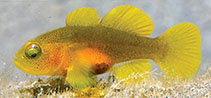
Épines dorsales (Total) : 7; Rayons mous dorsaux (Total) : 10 - 11; Épines anales: 1; Rayons mous anaux: 8 - 9. This species is distinguished by the following characters: D VI-I,10-11; A I,8-9; pectoral-fin rays 19; with anterior nostrils; no scales; pelvic disc with distinct frenum; mid-lateral row of widely-spaced sensory papillae on side of body and approximately 15 scattered sensory papillae on middle portion of caudal fin; body depth 3.0-3.4 in SL; head length 2.7-2.9 in SL; head compressed, width 1.1-1.4 in head depth; rounded caudal fin, shorter than head, in SL; colour in life generally brown except the yellowish head and fins with dense covering of tiny brown chromatophores, those of pectoral and pelvic fins are mainly confined to basal half of fin; iris yellow (Ref. 107278).
Body shape (shape guide): fusiform / normal; Cross section: compressed.
The type specimens were obtained within 100 m of each other on an approximately 20° mud slope. Two specimens were collected together from the inside of a dead bivalve while the other two were found on either filamentous algae or sponge that covered bottom debris, including a piece of wood and a cement block, and a fifth uncollected specimen was also observed and photographed in the same dead bivalve mentioned above (Ref. 107278).
Cycle de vie et comportement reproducteur
Maturité | Reproduction | Frai | Œufs | Fécondité | Larves
Allen, G.R., 2015. Lubricogobius nanus, a new species of goby (Pisces: Gobiidae) from eastern Papua New Guinea. J. Ocean Sci. Found. 17:1-11. (Ref. 107278)
Statut dans la liste rouge de l'IUCN (Ref. 130435: Version 2025-2 (Global))
Menace pour l'homme
Harmless
Utilisations par l'homme
Pêcheries: sans intérêt
Outils
Articles particuliers
Télécharger en XML
Sources Internet
Estimations basées sur des modèles
Indice de diversité phylogénétique (Réf.
82804): PD
50 = 0.5078 [Uniqueness, from 0.5 = low to 2.0 = high].
Bayesian length-weight: a=0.01023 (0.00477 - 0.02194), b=3.01 (2.83 - 3.19), in cm total length, based on LWR estimates for this (Sub)family-body shape (Ref.
93245).
Niveau trophique (Réf.
69278): 2.9 ±0.3 se; based on size and trophs of closest relatives
Résilience (Réf.
120179): Haut, temps minimum de doublement de population inférieur à 15 mois (Preliminary K or Fecundity.).
Vulnérabilité de la pêche (Ref.
59153): Low vulnerability (10 of 100).
🛈