分類 / 名前
共通名の | 類義語 | Catalog of Fishes(部類, 種) | ITIS | CoL | WoRMS | Cloffa
>
Characiformes (Characins) >
Curimatidae (Toothless characins)
Etymology: Cyphocharax: Greek, kyphos = curved, humpback + Greek, charax = a marine fish without identification (Ref. 45335); aninha: The specific name refers to the nickname of Ana Prudente (MPEG), wife of the first authors and pays tribute to her contributions towards the understanding of the Neotropical fauna, specifically the systematics of snakes.
環境:環境 / 気候帯 / 深さの範囲 / 分布範囲
生態学
; 新鮮な水 底生の漂泳性. Tropical
South America: Rio Mopeco, a left tributary of the Rio Parui in Pará, Brazil.
サイズ / 重さ / 年齢
成熟: Lm ? range ? - ? cm
Max length : 3.9 cm SL オス/雌雄の選別がない; (Ref. 94769)
簡単な記述
検索表 | 形態学 | 形態計測学
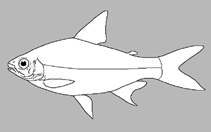
背鰭 (合計) : 11 - 12; 臀鰭: 9 - 10; 脊つい: 29 - 30. Cyphocharax aninha is distinguished from its congeners with the exception of C. vexillapinnus, C. gangamon, C. signatus, and C. punctatus, by the absence of or having extremely reduce infraorbital sensory canal, when present, in largest specimens (30.0 mm SL), to a fleshy or osseous canal in the fifth infraorbital (vs. canal always present and complete). It further differs from its congeners (except C. saladensis, C. vexillapinnus, C. signatus, C. punctatus, and juveniles of C. gangamon) by the possession of four to nine, modally seven, pored scales on lateral line (vs. more than ten). It can be further distinguished from its congeners, except C. santacatarinae, by having a large, ellipsoid, vertically oriented spot almost forming a bar at the rear of the caudal peduncle and over the base of the caudal-fin rays (vs. absence of a spot in C. abramoides, C. aspilos, C. derhami, C. festivus, C. leucostictus, C. magdalenae, C. microcephalus, C. multilineatus, C. nagelii, C. nigripinnis, C. notatus, C. platanus, C. pinnileps, C. plumbeus, C. stilboleps, C. vexillapinnus, or circular or lozenge-shaped, horizontally oriented, spot typically concentrated on the center of the caudal peduncle and not reaching the dorsal and ventral margins of the peduncle in C. biocellatus, C. gangamon, C. gilbert, C. gillii, C. gouldingi, C. helleri, . laticlavius, C. meniscaprorus, C. mestomyllon, C. modestus, C. oenas, C. pantostictos, C. punctatus, C. signatus, C. spilotus, C. piluropisis, C. spilurus, C. vanderi, and C. voga). It is also distinguished from C. helleri, C. laticlavius, C. multilineatus, and C. pantostictos by the absence of series of longitudinal dark continuous or discontinuous lines on the body (vs. presence of such pigmentation). It is can be separated from C. notatus and . vexillapinnus by the absence of a spot on the dorsal fin (vs. presence); and from C. biocellatus, C. punctatus, C. vanderi, and C. voga by the absence of circular or ellipsoid spots on the flanks (vs. presence). It can be diagnosed from its congeners, except C. signatus, in having 10-12, rarely 13 or 14 branched pectoral-fin rays (vs. 13 -17). It can be further distinguished from C. signatus by the tip of last branched ray of anal fin not reaching the base of the caudal-fin rays (vs. reaching). It further differs from C. saladensis by the caudal-peduncle height 10.4-14.4% SL (vs. 15.0-17.0)% SL), and the interorbital width 33.1-43.8% HL (vs. 44.0-50.0)% HL); from C. spilotus by the distance from snout to anus 67.2-77.7% CP (vs. 78.0-82.0% CP); from C. santacatarinae in the orbital diameter 32.2-43.3% HL (vs. 26.0-30.0% HL) and by having 30 or 31 total vertebrae (vs. 32-34); and from C. pinnilepis by having 9 or 10 middorsal scales from the supraoccipital process to the dorsal-fin origin (vs. 11-13) (Ref. 94769).
Body shape (shape guide): elongated.
ライフサイクルと交尾行動
成熟 | 繁殖 | 放精 | 卵 | 生産力 | 幼生
Wosiacki, W.B. and D.P. da Silva Miranda, 2013. Description of a new small species of the genus Cyphocharax (Characiformes: Curimatidae) from the Lower Amazon basin. Copeia 2013(4):627-633. (Ref. 94769)
IUCNのレッドリストの状況は (Ref. 130435: Version 2025-2 (Global))
人間の用途
用具
特記事項
XMLをダウンロードして下さい
インターネットの情報源
モデルに基づく推定値
系統多様性指数 (参照
82804): PD
50 = 0.5000 [Uniqueness, from 0.5 = low to 2.0 = high].
Bayesian length-weight: a=0.01445 (0.00642 - 0.03257), b=3.02 (2.84 - 3.20), in cm total length, based on LWR estimates for this Genus-body shape (Ref.
93245).
回復力 (参照
120179): 高い, 15か月以下の倍増期間の最小個体群 (Preliminary K or Fecundity.).
漁業の脆弱性 (Ref.
59153): Low vulnerability (10 of 100).
🛈