Ταξινόμηση / Ονόματα
Κοινά ονόματα | Συνώνυμα | Catalog of Fishes(Γένος, Είδη) | ITIS | CoL | WoRMS | Cloffa
>
Characiformes (Characins) >
Curimatidae (Toothless characins)
Etymology: Cyphocharax: Greek, kyphos = curved, humpback + Greek, charax = a marine fish without identification (Ref. 45335); aninha: The specific name refers to the nickname of Ana Prudente (MPEG), wife of the first authors and pays tribute to her contributions towards the understanding of the Neotropical fauna, specifically the systematics of snakes.
Περιβάλλον: περιβάλλον / κλιματική ζώνη / εύρος βάθους / εύρος διανομής
Οικολογία
; Γλυκού νερού βενθοπελαγικό. Tropical
South America: Rio Mopeco, a left tributary of the Rio Parui in Pará, Brazil.
Μέγεθος / Βάρος / Ηλικία
Γεννητική Ωρίμανση: Lm ? range ? - ? cm
Max length : 3.9 cm SL αρσενικό/απροσδιόριστο; (Ref. 94769)
Σύντομη περιγραφή
Κλείδες προσδιορισμού | Μορφολογία | Μορφομετρία
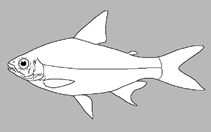
Μαλακές ραχιαίες ακτίνες (συνολικά) : 11 - 12; Μαλακές εδρικές ακτίνες: 9 - 10; Σπόνδυλοι: 29 - 30. Cyphocharax aninha is distinguished from its congeners with the exception of C. vexillapinnus, C. gangamon, C. signatus, and C. punctatus, by the absence of or having extremely reduce infraorbital sensory canal, when present, in largest specimens (30.0 mm SL), to a fleshy or osseous canal in the fifth infraorbital (vs. canal always present and complete). It further differs from its congeners (except C. saladensis, C. vexillapinnus, C. signatus, C. punctatus, and juveniles of C. gangamon) by the possession of four to nine, modally seven, pored scales on lateral line (vs. more than ten). It can be further distinguished from its congeners, except C. santacatarinae, by having a large, ellipsoid, vertically oriented spot almost forming a bar at the rear of the caudal peduncle and over the base of the caudal-fin rays (vs. absence of a spot in C. abramoides, C. aspilos, C. derhami, C. festivus, C. leucostictus, C. magdalenae, C. microcephalus, C. multilineatus, C. nagelii, C. nigripinnis, C. notatus, C. platanus, C. pinnileps, C. plumbeus, C. stilboleps, C. vexillapinnus, or circular or lozenge-shaped, horizontally oriented, spot typically concentrated on the center of the caudal peduncle and not reaching the dorsal and ventral margins of the peduncle in C. biocellatus, C. gangamon, C. gilbert, C. gillii, C. gouldingi, C. helleri, . laticlavius, C. meniscaprorus, C. mestomyllon, C. modestus, C. oenas, C. pantostictos, C. punctatus, C. signatus, C. spilotus, C. piluropisis, C. spilurus, C. vanderi, and C. voga). It is also distinguished from C. helleri, C. laticlavius, C. multilineatus, and C. pantostictos by the absence of series of longitudinal dark continuous or discontinuous lines on the body (vs. presence of such pigmentation). It is can be separated from C. notatus and . vexillapinnus by the absence of a spot on the dorsal fin (vs. presence); and from C. biocellatus, C. punctatus, C. vanderi, and C. voga by the absence of circular or ellipsoid spots on the flanks (vs. presence). It can be diagnosed from its congeners, except C. signatus, in having 10-12, rarely 13 or 14 branched pectoral-fin rays (vs. 13 -17). It can be further distinguished from C. signatus by the tip of last branched ray of anal fin not reaching the base of the caudal-fin rays (vs. reaching). It further differs from C. saladensis by the caudal-peduncle height 10.4-14.4% SL (vs. 15.0-17.0)% SL), and the interorbital width 33.1-43.8% HL (vs. 44.0-50.0)% HL); from C. spilotus by the distance from snout to anus 67.2-77.7% CP (vs. 78.0-82.0% CP); from C. santacatarinae in the orbital diameter 32.2-43.3% HL (vs. 26.0-30.0% HL) and by having 30 or 31 total vertebrae (vs. 32-34); and from C. pinnilepis by having 9 or 10 middorsal scales from the supraoccipital process to the dorsal-fin origin (vs. 11-13) (Ref. 94769).
Body shape (shape guide): elongated.
Κύκλος ζωής και συμπεριφορά ζευγαρώματος
Γεννητική Ωρίμανση | Αναπαραγωγή | Γεννοβολία | Αβγά | Γονιμότητα | Προνύμφες
Wosiacki, W.B. and D.P. da Silva Miranda, 2013. Description of a new small species of the genus Cyphocharax (Characiformes: Curimatidae) from the Lower Amazon basin. Copeia 2013(4):627-633. (Ref. 94769)
Κατάσταση Κόκκινου Καταλόγου IUCN (Ref. 130435: Version 2025-2 (Global))
Απειλή για τον άνθρωπο
Harmless
Ανθρώπινες χρήσεις
Εργαλεία
Ειδικές εκθέσεις
Λήψη XML
Διαδικτυακές πηγές
Εκτιμήσεις βάσει μοντέλων
Δείκτης φυλογενετικής ποικιλότητας (Αναφ.
82804): PD
50 = 0.5000 [Uniqueness, from 0.5 = low to 2.0 = high].
Bayesian length-weight: a=0.01445 (0.00642 - 0.03257), b=3.02 (2.84 - 3.20), in cm total length, based on LWR estimates for this Genus-body shape (Ref.
93245).
Ελαστικότητα (Αναφ.
120179): Υψηλό, ελάχιστος χρόνος για διπλασιασμό πληθυσμού < 15 μήνες (Preliminary K or Fecundity.).
Ευπάθεια στην αλιεία (Ref.
59153): Low vulnerability (10 of 100).
🛈